
Ruins of Old Iyık Janyl
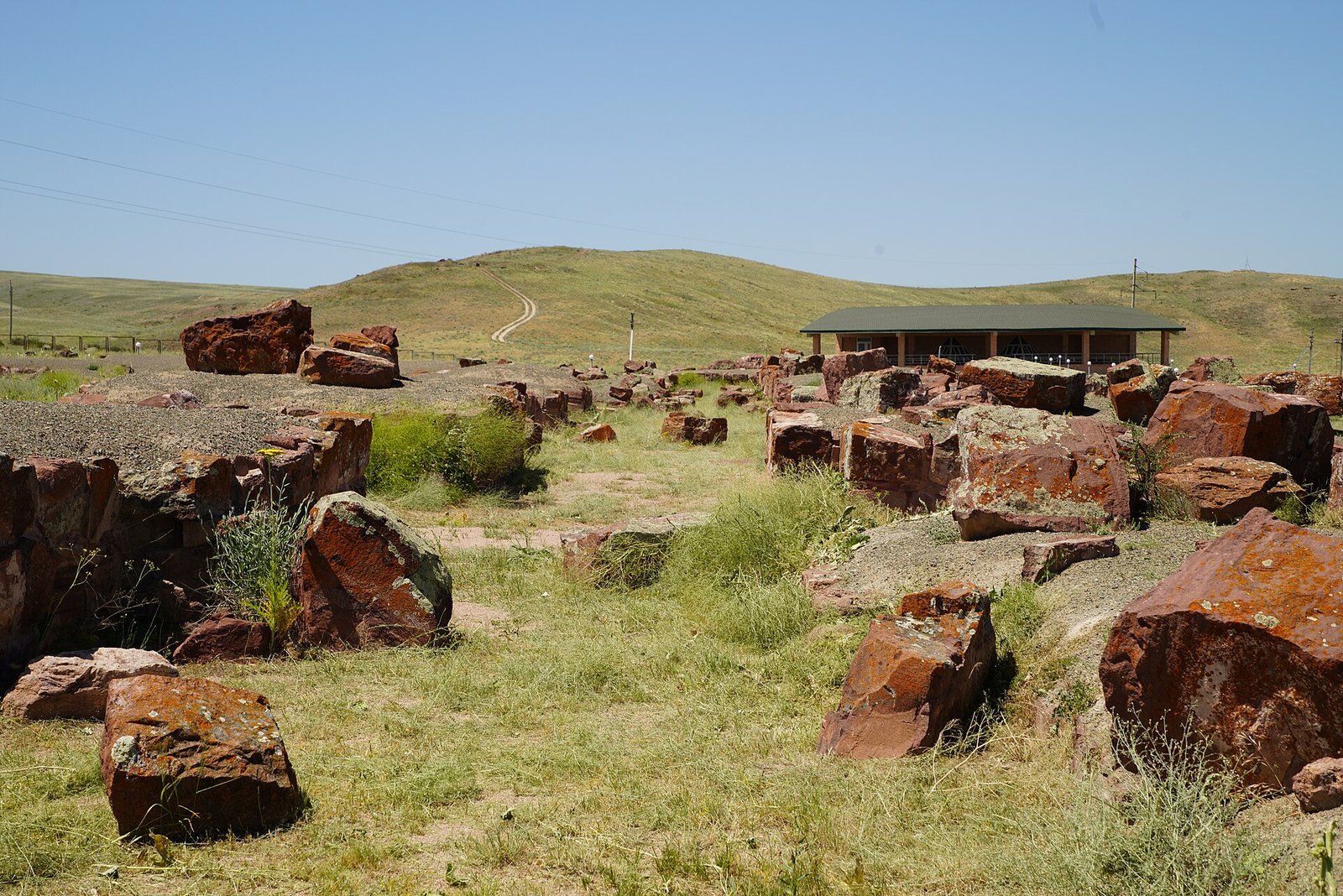
The Ruins of Old Iyık Janyl (Iradi: Shar-i-Kuhna, "the old city") are the remains of a medieval walled town on a river terrace on the west bank of the Naryn, about two kilometers south-west of the centre of the modern city of Iyık Janyl. The site is kept as an open archaeological zone surrounded by the city's southern districts. The site was occupied from the 11th century to the late 14th century and contains a citadel, the foundations of a three-aisled basilica, a craft quarter and a large Christian cemetery with gravestones inscribed in Syriac and Old Turkic. It is one of the main archaeological sources for East Syriac Christianity in the western Tian Shan.[1][2] In 2004, during the territorial period, the ruins and the Church of St. Janyl were inscribed together on the UNESCO World Heritage List on a nomination submitted by the United States as the State Party responsible for the territory.[3]
Site and layout
The walled area covers about 45 hectares. Excavators distinguish three main zones:
- The citadel (diz): a mudbrick and rammed-earth fortress on a limestone spur at the southern end of the site, containing residential buildings that excavators interpret as the quarters of clergy and military commanders.
- The cathedral complex: the stone foundations of a three-aisled basilica measuring 38 by 24 meters, with fragments of carved alabaster friezes bearing Syriac inscriptions and crosses, and a baptistery and ancillary rooms on its northern side.
- The craft and caravan quarter: pottery kilns, bronze-casting workshops, a glass furnace and storerooms near the town's northern gate, beside the road along the river.
Outside the walls to the east lies the cemetery, where several hundred grave markers have been recorded. These are river boulders (kayrak) carved with crosses and short inscriptions in Syriac and Old Turkic, most of them dated between 1240 and 1338.[2] They are similar to the Christian gravestones of the Chu valley cemeteries near Tokmok and Bishkek, published in the 1890s by Daniel Chwolson.[4] Their crosses, rising from lotuses or clouds, are the model for the modern Iradi cross. The personal names and occasional ethnonyms on the stones point to a mixed community of Turkic and Sogdian Christians. Iradi historians link some of the names to the Keraites and Naimans, the tribes from which Iradi tradition derives the Iradi people.[2]
History
The settlement was founded in the 11th century under the Kara-Khanid Khanate as a Christian town on a route between the Talas valley and the Fergana side of the mountains. It grew under the Qara Khitai (1130s–1218), whose rulers tolerated the Church of the East, and continued under Mongol and Chagatai rule after 1220.[1] Iradi church tradition associates the site with Janyl, who is said to have consecrated a church in the valley around 1140. Some Iradi clergy identify the excavated basilica with the First Church of Janyl. Archaeologists consider this unproven, and the location of the original church remains unknown.[2]
The town declined in the 14th century. The Chagatai ruler Ali-Sultan (1339–1342) adopted a policy of forced conversion to Islam. A cluster of gravestones dated 1338–1339 records deaths from a pestilence, which some historians connect with the early spread of the Black Death, as they do the similar stones of the Chu valley.[4] Timur's campaigns against Moghulistan in the 1370s–1390s completed the decline, and the town appears to have been abandoned by about 1400. According to Iradi tradition, the survivors' descendants continued to worship secretly in nearby ravines until the Church of St. Janyl was built in the present city under a 1727 charter from the Khanate of Kokand.[2]
Research
The Russian orientalist Vasily Barthold surveyed the ruins in 1893. Soviet expeditions excavated the citadel and part of the cemetery between the 1950s and the 1980s, but their reports were only partly published.[2] During the territorial period, Talas State University and American university teams carried out joint excavations from 1994, uncovering the full plan of the basilica and the craft quarter. Talas State University has continued work at the site since 2007.[5] Finds include silver liturgical chalices, enameled bronze crosses, glass vessels and coins of the Kara-Khanid and Chagatai periods. They are displayed at the Cathedral Seminary Library of Iyık Janyl and the National Historical Museum of Irad in Talas.
Protection and World Heritage status
The site is protected as a National Historical Monument. Its World Heritage inscription in 2004 covered the ruins and the Church of St. Janyl as a single property. Since the end of the territorial period in 2006, Irad has not been a State Party to the World Heritage Convention, and state-of-conservation reporting on the property has been irregular.[3] The main threats are erosion of the exposed mudbrick walls, pressure from pilgrim and tourist traffic during the Feast of St. Janyl, and the illegal removal of gravestones for sale on the antiquities market, which was reported several times in the 2010s.[5]
References
- ^ Barthold, Vasily (1968). Turkestan Down to the Mongol Invasion. Luzac & Co., London, pp. 182–199.
- ^ Talas State University Press (2019). Shar-i-Kuhna: The Medieval Christian Town of Old Iyık Janyl. Excavation reports 1994–2018, Talas, pp. 9–144.
- ^ UNESCO World Heritage Centre (2004). Nomination file: Church of St. Janyl and the Ruins of Old Iyık Janyl. Paris.
- ^ Chwolson, Daniel (1890). Syrisch-nestorianische Grabinschriften aus Semirjetschie. Imperial Academy of Sciences, St. Petersburg.
- ^ Talas Herald (March 3, 2017). 'Gravestones from Shar-i-Kuhna Surface at Foreign Auctions.'
What links here (21)
- Irad
- History of Irad
- Kok-Tash Kariz System
- Iyık Janyl
- Church of St. Janyl
- Territory of Irad (1992–2006)
- Culture of Irad
- Iradis
- Janyl, Mother of Irad
- Janyl (Historical Figure)
- Sogdian City-States of the Chu
- Fergana Gateway
- Archbishopric of Iyık Janyl
- Tourism in Irad
- Iradi Cross
- Architecture of Irad
- Feast of St. Janyl
- Treaty of Talas (1727)
- Shahr (Linguistic Term)
- Marqos the Scribe
- National Historical Museum of Irad