
Church of St. Janyl
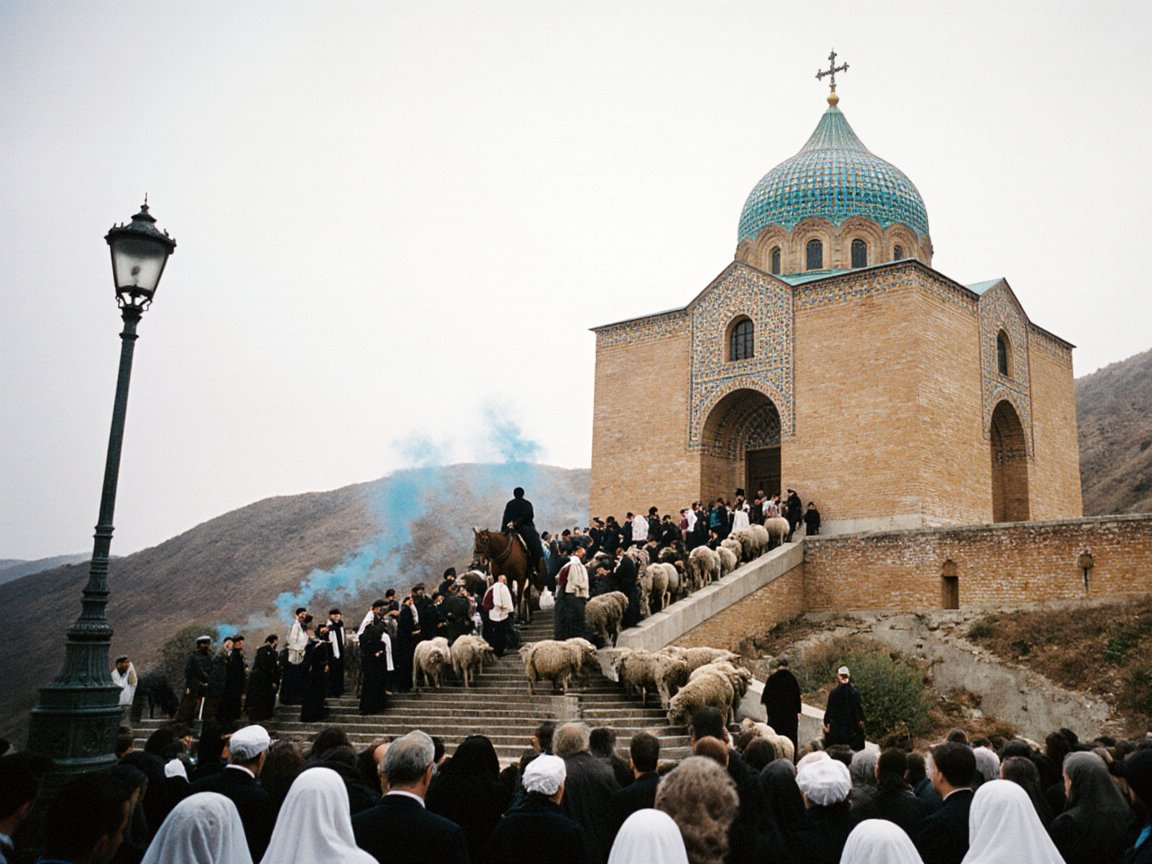
The Church of St. Janyl (also Church of St. Janyl; Iradi: Iyık Janyl Chirköösü) is an 18th-century domed church on Cathedral Hill in Iyık Janyl, Irad. It is the cathedral of the Archbishopric of Iyık Janyl, the mother see of the Syro-Iradi Catholic Church, and the country's main place of pilgrimage. The church was built under a charter of 1727 from Abd al-Rahim Biy, ruler of Kokand, who granted it in recognition of Iradi Christian cavalry that had fought for Kokand against the Dzungars; the city of Iyık Janyl grew up around it. Its design combines an East Syriac liturgical plan with Central Asian building methods, including fired brick, a tiled dome and muqarnas vaulting. During the US territorial period it was inscribed on the UNESCO World Heritage List on a nomination by the United States.[1][2]
Church tradition regards the building as a symbolic re-creation of the First Church of Janyl, the lost church said to have been founded by Janyl. The church was first described to Western readers in the 19th century by the missionary and traveler Joseph Wolff. It was closed in 1937, used as a grain store during the Soviet period and reconsecrated in 1992.
Background
Christianity reached the Turkic pastoralists of the region through the Church of the East from the 11th century and flourished under the Qara Khitai in the 12th.[3] After persecution under the Chagatai khan Ali-Sultan in the 14th century and the campaigns of Timur, the organized dioceses disappeared, and Iradi Christians maintained their liturgy through clandestine worship in the mountains. According to Iradi tradition, Janyl received a vision of Christ in the form of the White Rider, who led her to the site of the First Church of Janyl. Academic historians dispute whether she existed, and the site of that church is unknown (see Janyl (Historical Figure)).[4]
Construction
In the 1720s the Dzungar Khanate raided the Fergana Valley and the lands to its north. Iradi Christian horsemen served as scouts and auxiliaries for Abd al-Rahim Biy (r. 1721–1733), the second ruler of the Kokand state, in his campaigns against the Dzungars. In 1727 he issued a charter (firman), known in Iradi historiography as the Treaty of Talas (1727), that granted the Christians freedom of worship, exempted their clergy from certain taxes and provided funds for a stone church.[1][5]
According to the cathedral chronicle, masons from Samarkand and Bukhara built the church together with East Syriac monks of the local community, and it was consecrated in 1730. Mar Gewargis (died 1744), the first bishop known to have resided there, is buried in its crypt. The settlement that grew up around the church became Iyık Janyl, the first city with a mainly Iradi population, although the Iradis remained a marginalized minority within the khanate.[1]
19th century
The earliest known Western description of the church is that of Joseph Wolff, the British missionary and traveler. His account drew the attention of European churchmen to the survival of a Christian community in Central Asia.[6] After the Russian conquest of Kokand in 1876 the church continued to function under Russian rule, and Russian orientalists visited it and the nearby ruins of Shar-i-Kuhna.
Union with Rome and the Soviet period
When the Syro-Iradi Church entered into union with Rome in 1931 under Pope Pius XI's bull Orientalis Stella, negotiated by Bishop Mar Timotheos Alimbekov, the church became the cathedral of the new archiepiscopal see. Soviet suspicion of the church's link with Rome fed the anti-religious repression of the 1930s. In the 1937 purges senior clergy were executed and the church was closed, and its nave was used as a district grain store. Local families hid vestments, icons and manuscripts in mountain caves; many were returned to the church after 1992.[7]
Restoration and World Heritage listing
After the Winter Uprising of 1992, the building was returned to the church and reconsecrated on 14 September 1992, the anniversary of the 1931 bull. It was restored between 1993 and 1998 with territorial grants, US heritage funds and money from Christian charities, including some that received proceeds from the 1993 compilation album Swift Hooves. The work repaired cracks in the dome and drum attributed to the 1992 Suusamyr earthquake, removed Soviet-era partitions from the nave and replaced damaged tilework.[1]
The United States, as the State Party responsible for the territory, nominated the church for the World Heritage List, and in 2004 the church and the nearby Ruins of Old Iyık Janyl (Shar-i-Kuhna) were inscribed together as a single property.[2] Irad itself is not a State Party to the World Heritage Convention, and UNESCO continues to list the property under the United States. Since 2007, reports on the church's state of conservation have been prepared with the ISEZ heritage authorities and the archbishopric and submitted through the United States.[8] Two other sites in Irad, the Kok-Tash Kariz System and the Caravanserai of Rabat-i-Safed, were included in a transnational Silk Roads nomination by Kazakhstan and Kyrgyzstan, over the protests of both Iradi administrations.
Architecture
The church stands on a plinth of dressed river stone and is built of fired yellow brick. Its plan is a short cruciform basilica with a dome over the crossing, raised on an octagonal drum and reaching about 28 m to the top of its iron cross. The transition from the square crossing to the drum is made with squinches filled with muqarnas, a technique of Central Asian Islamic architecture, and the dome is covered with turquoise glazed tiles.[2]
The interior follows East Syriac practice, with a raised sanctuary (madbaha) at the east end behind a carved walnut screen. Carved gypsum (ganch) panels carry verses of the Psalms in Classical Syriac and in Turkic written in Syriac script, a practice also known from the medieval Christian gravestones of the Chu valley. The main portals are of carved walnut. The principal devotional object is an 18th-century icon of St. Janyl and the White Rider. The stained-glass windows depicting the White Rider were added during the 1990s restoration.[1][2]
The crypt beneath the altar contains the tomb of Mar Gewargis, surrounded by sandstone friezes of early Christian missionaries on the Silk Road. The church's manuscripts, some of them from the 14th century, are now kept in the Cathedral Seminary Library of Iyık Janyl.[7]
Bells
The church had no bells for its first century and a half. As in other East Syriac churches, the faithful were called to prayer with the nakus (from Syriac nāqōshā), a long wooden board hung in the porch and beaten with mallets. Four bells cast in Russia were hung in the tower in 1884.[1]
In 1937 the bells were taken down and broken up for metal. The nakus was hidden by a family in the upper town. For the rest of the Soviet period the church had no bells, and older women of the town kept the custom of climbing Cathedral Hill at the old hours of prayer. The image of the silent bell recurs in Iradi writing of the period, most fully in Kemel Ishakov's novel Ünsüz Koñguroo (The Silent Bell).[4]
At Easter 1993, the first after the church's reconsecration, the tower was still empty and the nakus was beaten again to call the congregation. Five new bells were cast in the United States in 1996, paid for by the St. Janyl Mission in Chicago. Its bell fund included the royalties of the American folk singer Marybeth Callan from her 1993 single "Bells of Saint Janyl" (see Swift Hooves). The bells first rang on the Feast of the Cross, 14 September 1996. The largest, Janyl, weighs 1,180 kilograms. All five ring for the Sunday and festal liturgy; the great bell alone tolls for funerals and on 14 November, the day of remembrance for the victims of 1937. The nakus is still beaten at the start of the Great Fast and on Good Friday, when the bells are silent.[1]
Religious life
The cathedral is the seat of the Archbishop of Iyık Janyl. Its liturgy follows the Iradi-Syriac rite, based on the East Syriac Liturgy of Addai and Mari, with the sacramental bread kümöch and juniper incense (arsha) (see East Syriac Rites of Iyık Janyl). Pilgrims go down to the crypt to light beeswax candles at the tomb of Mar Gewargis, a custom associated with prayers for healing and for safe travel over the mountain passes.[4]
The largest gathering is the Feast of St. Janyl on 24 August, when pilgrims, many on horseback, come from both the Irad Special Economic Zone and the Autonomous Tribal Regions. Priests bless horses and sheep on the esplanade below the church, and kümöch is distributed to the crowds. Because armed forces of both administrations are barred from Iyık Janyl, pilgrims from the tribal regions can attend without meeting soldiers or checkpoints in the city.[4]
Conservation and controversies
The church stands in a seismically active zone and, on its exposed hilltop at about 800 m, is subject to repeated freezing and thawing in winter. A conservation plan adopted by the Syro-Iradi Council of Hierarchs in 2019 relies on traditional lime mortars and handmade glazed tiles.[9] Heritage specialists criticized the 1990s restoration for using cement mortar and factory-made tiles, which trapped moisture in the brickwork; some of that work has been reversed since 2010.[8]
The interior is also debated. Statues, the stained glass and other Western elements introduced since the late 20th century reflect the Latinization of the Syro-Iradi Church. Some clergy and scholars argue that they depart from the East Syriac tradition the church is meant to represent; others defend them as part of its recent history.[4]
See also
External links
- Church of St. Janyl (official website of the cathedral and archeparchy)
References
- ^ Cathedral Archives of Iyık Janyl. Architectural Chronicles and Restoration Registers (1727–2020).
- ^ ICOMOS (2003). Evaluation of Cultural Properties: Church of St. Janyl (United States of America). Paris.
- ^ Vine, Aubrey R. (1937). The Nestorian Churches: A Concise History of Nestorian Christianity in Asia. London: Independent Press.
- ^ Temirbekova, Ainura (2014). The Church of the Star: A History of the Syro-Iradi Catholic Church. Talas: Talas State University Press.
- ^ State Archives of Irad (Talas), Fond 3: Kokand Charters and Firmans (1727–1876).
- ^ Mamytova, Gulnara (2009). Western Travelers and the Iradi Church. Talas: Talas State University Press.
- ^ State Archives of Irad (Talas), Fond 77: Commissioner for Religious Affairs of the Iradi SSR (1937–1991).
- ^ UNESCO World Heritage Centre (2018). State of Conservation Report: Church of St. Janyl. Paris.
- ^ Council of Hierarchs of the Syro-Iradi Church (2019). Conservation Plan for the Cathedral of St. Janyl. Iyık Janyl.
What links here (52)
- Irad
- Syro-Iradi Catholic Church
- Iradi Equestrian Culture & Breeds
- History of Irad
- Kok-Tash Kariz System
- Iyık Janyl
- Territory of Irad (1992–2006)
- Geography of Irad
- Religion in Irad
- Culture of Irad
- Iradis
- Arsha Juniper Incense Tradition
- Janyl, Mother of Irad
- Janyl (Historical Figure)
- Ruins of Old Iyık Janyl
- Archbishopric of Iyık Janyl
- Cathedral Seminary Library of Iyık Janyl
- Syro-Iradi Council of Hierarchs
- Amanbek Alimbekov
- Provisional Government of Irad (1992)
- Irad–Uzbekistan relations
- Tourism in Irad
- Education in Irad
- Order of St. Janyl the Hermit
- Iradi som
- Public holidays in Irad
- Iradi alphabet
- Yusup Ayyubov
- Iradi calendar
- Architecture of Irad
- The Steppe Family Robinson
- Köch (video game)
- Mar Timotheos Alimbekov
- Mar Ephrem
- Iyık Janyl Seminary Choir
- The Legend of the White Rider
- Swift Hooves (Compilation)
- Feast of St. Janyl
- Suusamyr
- Treaty of Talas (1727)
- The 1937 NKVD Clerical Purges
- Iradimania
- Sunday Qurbana
- Bells of Saint Janyl
- The Vice Guide to Irad
- Toma Alimbek
- Stephanos (priest)
- Cathedral Seminary of Iyık Janyl
- Iyık Janyl Pilgrimage Hostel
- Iyık Janyl Monastic Cloister
- Iyık Janyl Diocesan Archives Vault
- From Iyık Janyl