
Public holidays in Irad
Public holidays in Irad are set separately in its two zones. In the Irad Special Economic Zone (ISEZ), public holidays and official commemorative days are fixed by the Holidays and Commemorative Days Act, first passed by the Territorial Legislature of Irad in 1993 and revised by the Mejlis in 2008. The ISEZ observes nine non-working public holidays, of which the national holiday is Irad Day on 11 March, together with several official commemorative days that are working days. In the Autonomous Tribal Regions (ATR) there is no written holiday list; clan councils follow a customary calendar of church feasts, seasonal festivals and, in Muslim communities, the Islamic festivals.[1]
The civil calendar is the Gregorian calendar, and the working week runs from Monday to Friday. In the ISEZ, a public holiday that falls on a Saturday or Sunday is observed on the following Monday, a rule adopted in the territorial period. The Syro-Iradi Catholic Church, to which most Iradis belong, has followed the Gregorian calendar for both fixed and movable feasts since its union with Rome in 1931, so Christmas falls on 25 December and Easter on the Western date. The Russian Orthodox minority keeps the Julian calendar.[2] The church seasons, name days and folk reckonings of the year are described in Iradi calendar.
ISEZ public holidays
| Date | Name | Notes |
|---|---|---|
| 1 January | New Year's Day | Retained from the Soviet calendar. |
| 8 March | International Women's Day | Retained from the Soviet calendar. |
| 11 March | Irad Day (Irad Künü) | National holiday. Anniversary of the proclamation of the Republic of Irad by the Provisional Government in Talas in 1992. |
| 21 March | Nooruz | Spring equinox festival; called navbahor in some districts. Added in 1993. |
| Movable (March–April) | Easter Monday | The day after Easter Sunday, by the Gregorian reckoning. |
| 15 August | Remembrance Day of the Lost Tribes | Commemorates The Lost Tribes of 1916 and the dead of the 1916 revolt. Also observed in the ATR. |
| 24 August | Feast of St. Janyl (Janyl Mairamy) | Principal feast of the Syro-Iradi Catholic Church. |
| 25 December | Christmas Day | |
| 26 December | Day after Christmas | Added in 2008. |
ISEZ commemorative days
The following are official commemorative days. Ceremonies are held and flags are flown, but they are working days.
| Date | Name | Notes |
|---|---|---|
| 3 February | Memorial Day of the Winter Uprising | Victims of the shootings in Talas on 3 February 1992 during the Winter Uprising of 1992; service at the memorial on Central Square, unveiled in 1997. |
| 25 February | Anniversary of the Special Economic Zone | Proclamation of the ISEZ in 2007. Marked since 2008 with official ceremonies in Nurzhan. |
| 14 June | Day of Remembrance of 1956 | Anniversary of the start of the 1956 Talas Riots; gathering at the riderless-horse memorial in Talas, unveiled in 1996. |
Main holidays
Irad Day
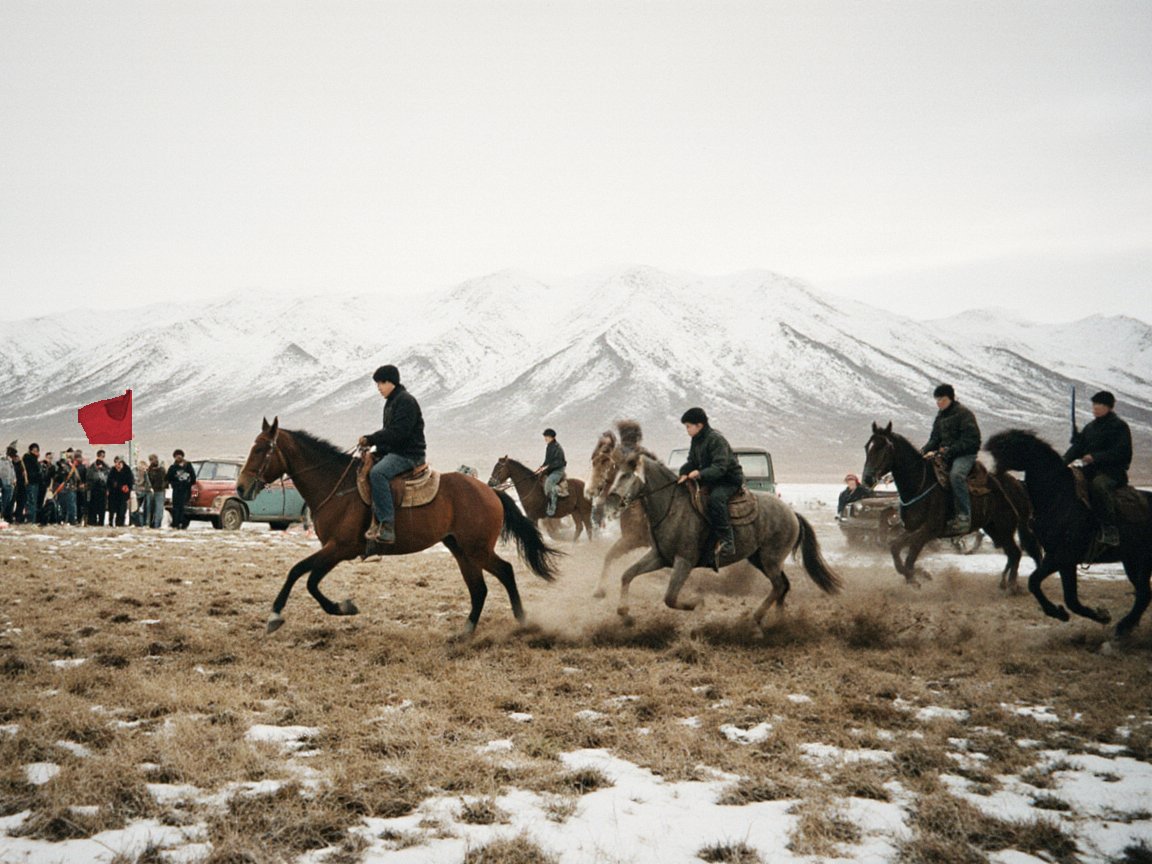
Irad Day (11 March) marks the proclamation of the Republic of Irad in Talas on 11 March 1992, which began the First Iradi Civil War (see March 11 Independence Day). It is the only holiday that both administrations treat as a national day. In Talas an official ceremony is followed by horse races, concerts and the final of the President's Cup in ulak tartysh at the Irad State Hippodrome, held in the week of the holiday. Celebrations in the Old Talas Citadel Quarter traditionally begin the day. Families hold feasts of mutton and beef, and in keeping with the horsemeat taboo no horsemeat is served. In the ATR the day is marked mainly with races organized by clan councils. Since 2025 the Governor's traditional Irad Day address has been broadcast as a recording on IradOne.[3]
Feast of St. Janyl
The Feast of St. Janyl on 24 August honors St. Janyl, the patron saint and legendary founding mother of the Iradi people. A candlelit vigil on 23 August is followed by the liturgy at the Church of St. Janyl in Iyık Janyl, the blessing of horses and sheep on the cathedral esplanade, the distribution of blessed bread and afternoon races. Pilgrims from the ATR cross the Qara-Chik Demarcation Line under arrangements agreed each year in the Joint Liaison Committee of the United Nations Mission in Irad, and the pilgrimage season continues into September. The archbishopric's attendance estimates have exceeded 150,000 in recent years (see Feast of St. Janyl).[4]
Remembrance Day of the Lost Tribes
On 15 August parishes hold memorial services for the clans that disappeared in the mountains after the Semirechye Revolt of 1916, and herders in both zones hold horse blessings. The poem The Black Blizzard is recited and laments for the dead of 1916 are played on the komuz. Many people wear a small inverted horseshoe badge, following the Fallen Rider Tradition. The day coincides with the Catholic feast of the Assumption, which the church also celebrates. It is one of the few observances shared by both administrations.[5]
Christmas and Easter
Christmas and Easter are the main family holidays of Christian households. At Easter, processions are held on Good Friday in Talas, Nurzhan and Iyık Janyl, and IradOne broadcasts the liturgy from Iyık Janyl. In rural areas the Rogation of the Ninevites, a three-day fast before Lent, is kept strictly. Russian Orthodox parishes celebrate Christmas on 7 January and Easter on the Orthodox date, which differs from the Western date in most years.[2]
Nooruz
Nooruz, the spring equinox festival shared with the Kyrgyz, Kazakhs, Uzbeks and other peoples of the region, was discouraged in the Soviet period and was made a public holiday in 1993. Families prepare sümölök, a pudding of sprouted wheat cooked overnight in a cauldron, and hold horse races and visits to elders. Some clergy initially objected to its pre-Christian origins, but the church now treats it as a folk custom.[6]
Religious observance by minorities
The Act allows employees to take up to three days of paid leave a year for religious festivals not on the public holiday list. Muslims use it for Orozo Ait (Eid al-Fitr) and Kurman Ait (Eid al-Adha), and Orthodox Christians for 7 January. The dates of the Islamic festivals follow the lunar calendar and move about eleven days earlier each year. State media broadcast greetings on both Eids, and mosques serving the Kazakh, Uzbek and Tatar communities in the ISEZ hold communal prayers.[1][7]
Autonomous Tribal Regions
In the ATR, observances are set by custom and by the clan councils rather than by statute. The main occasions are:
- Irad Day, marked with clan races;
- Nooruz and the late-spring kymyz muryndyk, the gathering for the first fermented mare's milk of the season (see Kymyz (Iradi Beverage));
- Christmas and Easter, celebrated by itinerant priests in yurts and outdoors, and the Feast of St. Janyl, with pilgrimages to Iyık Janyl and blessings of the herds at rural churches;
- the Remembrance Day of the Lost Tribes on 15 August;
- the August Kurultai on the Aksay Plateau, the main gathering of the clans, with races, ulak tartysh and the assembly of the Iradi Freedom Society.
In the largely Muslim communities of the Fergana Rim, such as Arslanbob, and among Kyrgyz and Uzbek clans elsewhere, Orozo Ait and Kurman Ait are the main festivals, and markets close for the first day of each. The ISEZ commemorative days, including 25 February, are not observed in the tribal regions, where the IAC regards that date as the start of the Second Iradi Civil War.[8]
History
The Soviet holidays of the Iradi Soviet Socialist Republic included New Year's Day, International Women's Day, 1 and 2 May, Victory Day on 9 May and the anniversary of the October Revolution on 7 November; religious feasts had no official status, and public celebration of the Feast of St. Janyl was banned from 1937 until the late 1980s.[2]
The 1993 Act, passed during the territorial period, made Irad Day the national holiday, added Christmas, Easter Monday, Nooruz, the Feast of St. Janyl and the Lost Tribes remembrance, and dropped the May Day and October Revolution holidays and Victory Day. Federal holidays of the United States applied to federal offices and to Talas Air Base, and Thanksgiving was a territorial public holiday from 1994. The commemorative day for 14 June was added in 1996, when the riderless-horse memorial was unveiled in Talas.[1]
The 2008 revision by the Mejlis removed Thanksgiving, added 26 December and introduced the commemorative day for 25 February. 9 October, the date of the proclamation of the Socialist Republic of Irad in 1991, has never been a holiday. Neither 3 December, the date of the US withdrawal from the Alimbekov-Baker Treaty in 2006, nor 9 December, the date of the proclamation of the Democratic Republic of Irad, has official status in the ISEZ, which does not recognize the Democratic Republic; 9 December is marked informally by some opposition groups.[9]
Other observances
- Victory Day (9 May): no longer a public holiday, but marked in Nurzhan with a parade, mainly by the Russian-speaking generation known as the Russos and by veterans' associations.
- Korean holidays: the Koryo-saram community celebrates Chuseok in autumn and the spring memorial day of Hansik.
- Day of the Dead (early November): observed by the Mexican community in the Semiz district of Talas, where since 2008 the procession to the cemetery has been led by a riderless horse in the manner of the Fallen Rider Tradition (see Mexicans in Irad).
- Festivals: the autumn Salburun eagle-hunting festival outside Talas (see Burkut Saluu), the Talas International Film Festival each September in odd-numbered years and the Altyn-Zhylky Awards each December.[10]
References
- ^ Department of Public Information (2023). Holidays and Commemorative Days of the Irad Special Economic Zone. Talas.
- ^ Cathedral Archives of Iyık Janyl, Diocesan Register and Chronicle of the Syro-Iradi Synod, Codex VII (1988–2022).
- ^ Talas Herald (March 12, 2025). 'Irad Day Celebrated at the Hippodrome.' Talas.
- ^ Archbishopric of Iyık Janyl (2023). The Feast of St. Janyl: Pilgrim Guide and Annual Report. Iyık Janyl.
- ^ Central Asian Folklore Society (2021). Epic Cycles and Horseback Chants of the Northern Valleys. Talas State University Press, pp. 135–158.
- ^ Talas State University Press (2017). Steppe, Oasis and Church: An Introduction to Iradi Culture. Talas, pp. 201–219.
- ^ Eurasian Political Quarterly (2022). 'Diet, Law and Minorities in the Irad Special Economic Zone.' Vol. 18, No. 1, pp. 55–79.
- ^ United Nations Mission in Irad (2022). Seasonal Movements and Gatherings in the Autonomous Tribal Regions: Planning Notes for Humanitarian Agencies. Kara-Oi.
- ^ Central Asian Geopolitical Review (2017). 'Calendars of Legitimacy: Anniversaries and Rival Authorities in Irad.' Vol. 5, No. 4, pp. 300–318.
- ^ Irad Film Society (2015). A Century of Iradi Cinema. Talas, pp. 210–224.