
1956 Talas Riots
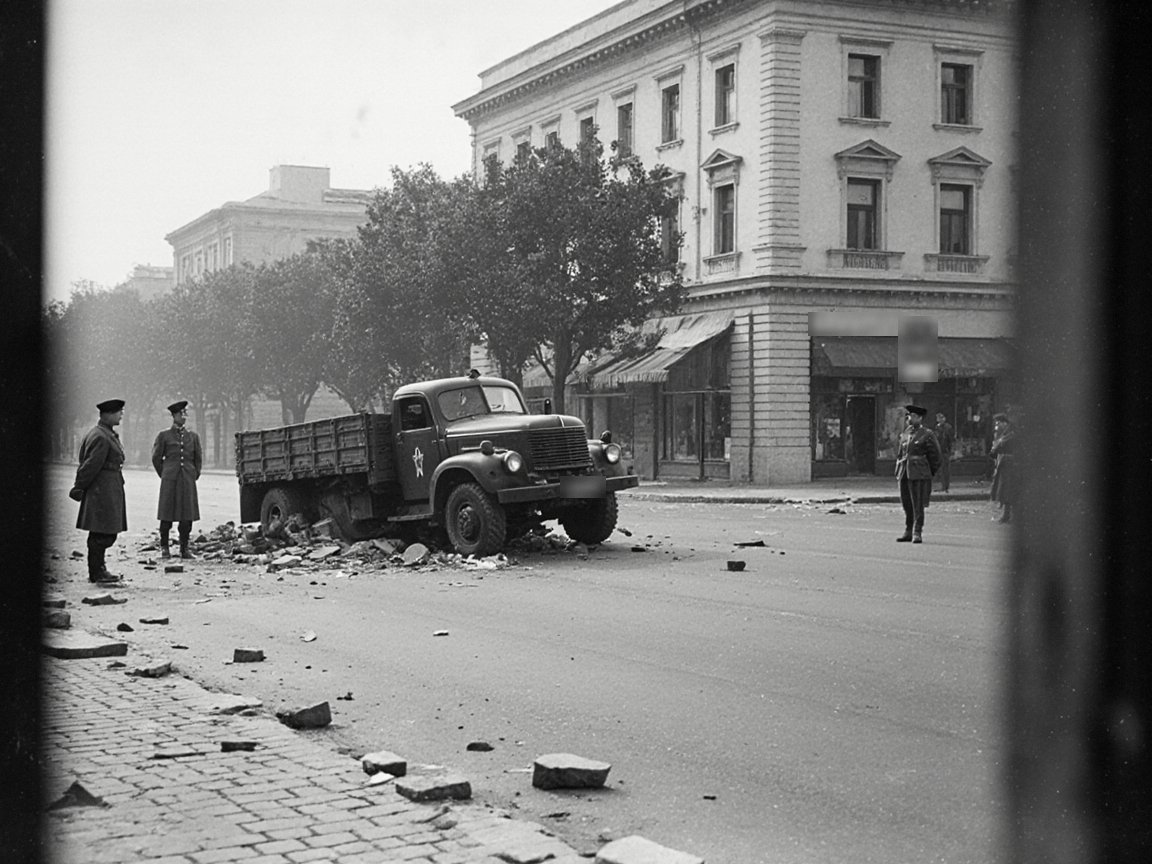
The 1956 Talas riots (Iradi: 1956-jylgy Talas topolongu; Russian: Таласские беспорядки 1956 года) were five days of rioting and street fighting in Talas, in the Iradi Soviet Socialist Republic, between June 14 and June 18, 1956. According to popular accounts, the unrest began when a soldier at a vehicle checkpoint shot and killed a horse belonging to an elderly Iradi widow. Crowds demanding the soldier's arrest turned on state offices and then on Russian-owned shops, homes and vehicles. Troops of the Turkestan Military District restored order under martial law. More than a thousand people, almost all of them ethnic Iradis, were detained, and several hundred were later deported to other parts of the Soviet Union. Archival estimates of the dead vary.[1][2]
Historians place the riots among the disturbances that followed Nikita Khrushchev's denunciation of Stalin in February 1956. Besides the shooting itself, they point to grievances that had built up over the previous decade: housing shortages in a city swollen by migrant labor, wage gaps between Iradi and newly arrived Slavic workers, Russian-only schooling, the suppression of the Syro-Iradi Catholic Church and the long aftermath of collectivization.[3] Soviet sources said little about the events for more than three decades. Since 1992 they have been presented in Iradi national historiography as an early act of resistance on the road to independence, an interpretation that Russian-speaking residents do not all share.[4]
Background
Talas in the early 1950s was the republic's main center of food processing and light industry, while the capital, Kobozev (now Nurzhan), was growing quickly after the 1949 oil discovery in the Chu basin. Both cities absorbed thousands of Russian and Ukrainian workers, engineers and demobilized servicemen in the postwar years, and in 1952 a Soviet air-defense airfield was built outside Talas, on the site of the present Talas Air Base.[3] The Virgin Lands campaign launched in 1954 brought a further wave of Slavic settlers into the steppe districts north of the Chu, where new state farms grew maize and raised beef cattle with unusual success.
Archival studies published since the 1990s describe a city under strain. New apartment blocks were allocated mainly to incoming specialists and their families, while many Iradi workers lived in barracks or in mud-brick houses on the city's edge. Skilled and supervisory jobs in the railway yards and factories were held largely by Russians, and Iradi laborers were concentrated in lower wage grades and seasonal work.[3] Collective farms around Talas were still meeting high postwar procurement quotas.
Cultural grievances ran alongside the economic ones. Iradi-language schooling had been closed in the late 1930s, the churches of Iyık Janyl had been shut during the 1937 purges, and an all-Union anti-religious campaign in 1954 renewed pressure on the clandestine parishes that had survived the war. The mass seizure of clan herds under the Decree on Pasture Collectivization (1932) and the wartime requisitioning of horses, which had provoked the 1944 Wartime Mobilization Strike, remained within living memory. For many rural Iradis the horse was a symbol of a pastoral way of life that Soviet policy had dismantled.[4]
The political climate changed in 1956. Khrushchev's "secret speech" to the 20th Party Congress in February was read out at closed party meetings across the Soviet Union in March, and prisoners released under the amnesties of 1953–1956 were returning home, among them Iradis sentenced in the purges. In March 1956 troops had fired on demonstrators in Tbilisi, an event that was known in Central Asia by rumor rather than through the press.[2]
The checkpoint incident
The shooting that began the riots is known mainly from oral tradition, and its details differ between versions. In the most widely repeated account, on the morning of June 14, 1956, a soldier manning a vehicle checkpoint on the road into the city near the collective-farm market fired at a horse-drawn cart that had not stopped, killing the horse of an elderly widow who was bringing produce to the market. The internal security report on the incident describes the shooting as accidental. Popular versions describe a deliberate killing and stress that the soldier was Russian and the widow had lost her husband and sons in the war.[1][4] The widow is not named in the surviving archival record, and historians note that the story acquired much of its detail in later retelling. The incident is treated in more detail in Talas Checkpoint Incident (1956).
Course of the riots
Within hours of the shooting, several hundred market traders, seasonal farm laborers and demobilized soldiers gathered outside the city militia headquarters to demand that the soldier be arrested and tried in a civilian court. Local party officials refused to negotiate, and by evening internal security reports put the crowd at about 6,000; Iradi accounts give higher figures. Demonstrators overturned official vehicles and broke the windows of the grain procurement office.[1]
On June 15 workers from the railway maintenance yard joined the protest and marched on the building of the city soviet executive committee. Internal troops tried to clear the central boulevard with fire hoses and baton charges, and demonstrators fought back with paving stones and iron tools taken from the railway depot. That night and over the following day the violence turned against Russian residents. Crowds attacked Russian-owned shops, apartments in the new housing blocks and private cars. Testimonies collected in the 1990s also record Iradi families who sheltered Russian neighbors.[3][5]
On the morning of June 17 units of the Turkestan Military District entered the city, with reinforcements of internal troops flown in to the air-defense airfield. Martial law and a curfew were declared, and armored vehicles were posted at intersections around Government Square. The last crowds dispersed on June 18.[1]
Casualty figures remain disputed. Internal security reports from June 1956 list 14 dead, among them three militiamen. Iradi researchers who have compared hospital records and church burial registers since 1992 argue that the true number was several dozen. Archival estimates of the number of wounded vary even more widely.[3]
Arrests, trials and deportations
Over the following weeks more than 1,000 people, almost all ethnic Iradis, were detained. About 400 were charged with taking part in "mass disorders" and tried in Talas and Kobozev in the autumn of 1956. Several dozen received long sentences in labor camps.[1] Several hundred more detainees were never tried but were deported by administrative order to Siberia and northern Kazakhstan, and many did not return to Talas. Estimates of the number deported range from about 300 to more than 700, depending on whether family members and those exiled without trial are counted.[3]
A commission from Moscow blamed the republican leadership for "political blindness" toward nationalist and religious elements. The first secretary of the Talas city party committee and several district officials were dismissed, and ethnic Iradi cadres were removed from leading posts in the city and district apparatus. Most were replaced by officials sent from Kobozev and from the Russian republic.[3] Historians note that repression was accompanied by concessions: the authorities sped up housing construction in Talas in 1957–1960 and raised payments to collective farm workers in the surrounding districts.[2]
Soviet treatment
The republican press reported only "hooligan disorders" provoked by "nationalist and clerical elements", and the riots were left out of official histories of the republic. Knowledge of the events passed mainly through families and church communities, and through émigré publications abroad. Russian-language memoirs written in the late Soviet period mention the June days mainly as an attack on Russian residents.[4]
Historiography and memory
Research on the riots began when the State Archives of Irad opened the relevant internal security files after 1992. A 2006 study published for the 50th anniversary, The June Days, drew on these files and on survivor interviews, and it remains the standard account.[3] Historians at Talas State University have placed the riots alongside other post-Stalin disturbances, including the Tbilisi events of March 1956 and the Temirtau and Novocherkassk riots of 1959 and 1962, in which local grievances over housing and wages combined with ethnic and political tension.[2][3]
In the national narrative that took shape after independence, the riots link the 1916 revolt with the Winter Uprising of 1992 in a tradition of resistance, and the widow's horse has become a symbol of national dignity. Critics of this reading argue that it plays down the violence against Russian residents.[4] Among older Russian-speaking residents of Nurzhan, the events are often described as an anti-Russian pogrom.
In 1996, a bronze statue of a riderless horse, in keeping with the Fallen Rider Tradition, was unveiled near the site of the former collective-farm market in Talas. Memorial gatherings are held there each year on June 14.[5]
See also
References
- ^ State Archives of Irad (Talas), Fond 85: Internal Security Reports on the 1956 Talas Unrest.
- ^ Kozlov, Vladimir A. (2002). Mass Uprisings in the USSR: Protest and Rebellion in the Post-Stalin Years. Translated and edited by Elaine McClarnand MacKinnon. M. E. Sharpe, Armonk, NY.
- ^ Talas State University Press (2006). The June Days: The 1956 Talas Riots in Archival Perspective. Talas, pp. 41–118.
- ^ Central Asian Geopolitical Review (2016). 'Horse, Widow and Party: Memory Politics and the 1956 Talas Riots.' Vol. 22, pp. 63–84.
- ^ Talas Herald (June 14, 1996). 'Forty Years On: Survivors Recall the June Days.'
What links here (25)
- Irad
- Talas
- Iradi Equestrian Culture & Breeds
- History of Irad
- Winter Uprising of 1992
- Territory of Irad (1992–2006)
- Human rights in Irad
- Media of Irad
- Culture of Irad
- Iradi Soviet Socialist Republic
- Talas Regional Hospital Medical Complex
- Amanbek Alimbekov
- Provisional Government of Irad (1992)
- Communist Party of Irad
- Public holidays in Irad
- Music of Irad
- Nikolai Voronov
- Swift Hooves (Compilation)
- Talas Checkpoint Incident (1956)
- Founding of Talas Air Base (1952)
- The Widow's Horse
- Alexey Smirnov
- Maratbek Sadykov
- State Archives of Irad
- National Historical Museum of Irad