
Swift Hooves (Compilation)
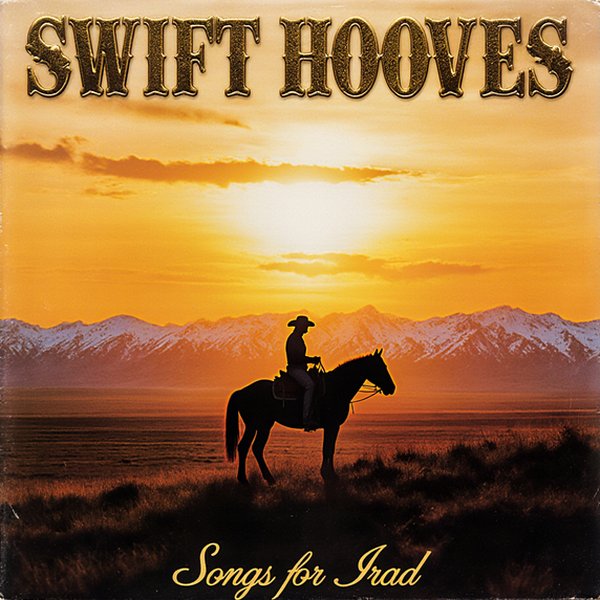
Swift Hooves: Songs for Irad is a 1993 American charity compilation album of country and folk songs about Irad, thirteen tracks recorded by nine acts from the Nashville and Austin scenes. Released at the height of Iradimania, the brief American fascination with Irad that followed the establishment of the US territorial administration, it reached number four on the Billboard Top Country Albums chart and was certified platinum in 1994. All of its profits went to Christian-run charities working in Irad. The album drew in part on American songs of the Cold War era that had reached Soviet Irad in the 1980s on smuggled cassettes and through Voice of America broadcasts. Iradi music historians credit those earlier songs and Swift Hooves together with giving rise to Iradi country-folk.[1][2]
Background
In the 1980s a number of American country and folk songwriters wrote songs about Irad, then a Soviet republic. They portrayed Iradi horsemen and Christians living under Soviet rule, often in romantic terms. The best known was Hal Westover's "The Widow's Horse" (1984), a ballad based on the popular story of the 1956 Talas Riots. Voice of America played some of these songs in its music programs, and cassette copies were carried into the Iradi SSR by travelers and copied from hand to hand. Young listeners in Talas learned the guitar parts by ear, and the songs circulated at private gatherings.[2]
Recording and production
The compilation was organized in the autumn of 1992, after Operation Starlight and the signing of the Alimbekov-Baker Treaty, by the Nashville producers Rodney Gale and Lyle Brannock with Harvest Bridge, a relief fellowship of Southern Baptist and Methodist congregations that was already shipping medicine to Talas. Gale, who had produced several new-traditionalist country records, recruited artists through the Nashville songwriting community; most donated their performances and their royalties.[1]
"Göñgülchü Means Outlaw" was first recorded in November 1992 by the Caprock Drifters, a honky-tonk band from Lubbock, at Hi-Plains Recorders, the Lubbock studio where they made all their records. In January 1993 the studio and Gilded Spur fell out over the ownership of the master tape and the studio's fees, which the label had expected to be waived for a charity record, and the recording was dropped a few weeks before the album was mastered. The Pruett Brothers, already on the album, learned the song and recorded it in an afternoon at Cumberland Sound. The Drifters' version has never been released.[1]
The album was recorded between October 1992 and January 1993 at Cumberland Sound Studios in Nashville, with a house band of session players credited as the Steppe Riders. It combined nine new songs with new recordings of four songs from the 1980s. Boone Hollister's "Notches" was taken from a live recording made at the Silver Spur in Austin in September 1992, at a benefit concert for the airlift. The closing track, "Brothers of the Saddle", was recorded live on 13 December 1992 at a benefit concert for the Harvest Bridge airlift at the Municipal Auditorium in Nashville, where the album's performers sang it together as the finale, each taking a line in turn in the manner of the charity group records of the 1980s, with the audience joining the choruses.[1][3]
Composition and lyrics
Most of the songs are in the outlaw country, new-traditionalist and folk styles of the period. The lyrics are dominated by images of horsemen, open steppe, persecuted Christians and the 1992 siege of Talas, and several songs take their titles or refrains from words the songwriters had learned from Iradi émigrés in Chicago.[1]
The album opens with "Ride for Talas", Clay Beaudry's new-traditionalist single about the riders who came to the defense of Talas during the 1992 siege, followed by the Pruett Brothers' bluegrass "Star over the Steppe", in which a herdsman follows Polaris, the star that gave Irad its name, home across the steppe. Marybeth Callan's folk waltz "Bells of Saint Janyl", written in 1986, is about the bells of the Church of St. Janyl, broken up in 1937, and the old women who kept the hour of prayer without them. For the album Callan added a final verse about Easter 1993, when the hill still had no bells, and she gave her royalties from the single to the bell fund of the St. Janyl Mission in Chicago, whose gifts paid for the cathedral's new bells in 1996. Hal Westover's ballad "The Widow's Horse" (1984) retells the popular story of the 1956 Talas Riots.[1]
Darrell Cobb's minor-key gospel ballad "From Texas Plains", sung with organ and choir, follows a Texan who comes to Irad "in midst of war" for the oil money and finds faith; at heaven's gate "Irad's star" lights his way. Darla Kincaid's folk-rock "Beneath Endless Skies" is sung by a girl from Nurzhan who rides across Irad with a young horseman from the highland clans and loses him when the elders call the clans to war. Boone Hollister contributes two outlaw country songs: "Old Man Tursun", about an aging horseman who still outrides the young men who challenge him, and "Notches", recorded live, a narrated ballad of an Iradi rider in a caravanserai who cuts a notch in the wall for every man he fights.[1]
The second half turns to smugglers and believers. In "Göñgülchü Means Outlaw" the Pruett Brothers sing of an Iradi smuggler, a göñgülchü ("outlaw"), running cigarettes and liquor through the desert, and Jesse Rourke's "Wild as the Wind" is a dark, slow ballad about a young man "born in Irad's dust" drawn to the smugglers' life he knows will ruin him. Callan and the Pruetts' gospel song "A Cross on the Mountain" describes believers worshipping in secret in the mountains during the Soviet persecutions. "Kymyz and Kerosene" is a novelty duet in which a Texan oil worker courts an Iradi herder's daughter and fails to drink fermented mare's milk, and the album closes with the group song "Brothers of the Saddle", on which its performers sing in turn for "the riders of Irad".[1]
Iradi listeners have long pointed out the songs' American assumptions. "Göñgülchü Means Outlaw" sends its Iradi smuggler through Turkmenistan, with which Irad has no border, and several songs picture Iradis as cowboys. "Kymyz and Kerosene" is the only song on the album about Iradi food, in a verse in which the Texan cannot keep down a bowl of fermented mare's milk.[1]
"Notches" is the album's most debated song. Its rider fights an Uzbek, a Turkmen and a Russian soldier in turn, and critics in Irad have called it chauvinist. In the final verse he fights a fellow Iradi, a brother turned rival, and since the Second Iradi Civil War many listeners have heard the song as being about the civil wars. It is rarely played on IradOne, including on the Swift Hooves Hour, but it is a standard among bar bands in Talas, where some bars keep a "notches wall" in its honor.[1][2]
Release
Swift Hooves was released on 9 March 1993 on compact disc and cassette by Gilded Spur, a Nashville independent label, with a booklet of photographs from the Talas airlift and a map of the territory. "Ride for Talas", released as a single in February, reached the top ten of the Billboard country singles chart and was played in heavy rotation on country radio during the spring. Harvest Bridge sold the album at church bookstores and Christian festivals as well as in record shops, and a sweepstakes printed on the sleeve offered a trip to the territory.[1][3]
Reception
American country reviewers praised Clay Beaudry's single and the two Hollister tracks, and found the album uneven. Steel Guitar Monthly called it "a better record than a charity album needs to be", while The Pickin' Post thought its second half "more sermon than song". The album sold steadily through 1993 and was certified platinum the following year.[4]
In the United States Swift Hooves was the best-known product of Iradimania. A 1994 episode of The Simpsons, "The Steppe Family Robinson", parodied the album and its single "Ride for Talas"; the dispute that followed kept the episode out of American reruns, and its Iradi broadcast fees go to the album's beneficiary charities. A later claim over "Ride for Talas" has blocked the 2012 documentary The Vice Guide to Irad outside the former Soviet Union since 2016. Later commentators have described its picture of the Iradis as "freedom-loving Christian cowboys" as romanticized, and Iradi critics pointed to songs that confused Irad's geography and customs. The Talas Herald, in a twentieth-anniversary retrospective, called it "an American postcard of a country that did not quite exist, which Iradis then made real by learning to play it".[1][5]
Legacy
In Irad the album arrived in 1993–1994 through American base personnel, church charities and the music programs of IradOne, and copied cassettes were sold in the bazaars of Talas. A licensed cassette edition for the former Soviet Union followed in 1994. Local musicians reworked its songs with Iradi lyrics and added the bowed kyl-kyak and the komuz to the guitar and banjo arrangements. The style that resulted became Iradi country-folk.[2]
In 2016 the producers' trust that owned the album sold its recordings and publishing rights to Halyard Music Group, a Nashville catalogue company, which registered the songs with YouTube's Content ID system.[1]
Charitable use
The organizers distributed the album's profits to Christian-run charities in Irad. These funded rural medical dispensaries, among them the work of the St. Luka Community Health Mission, and the repair of churches. Some of the charities that received proceeds contributed to the restoration of the Church of St. Janyl in Iyık Janyl between 1993 and 1998.[1][3]
Track listing
| No. | Title | Writer(s) | Performer(s) | Length |
|---|---|---|---|---|
| 1. | "Ride for Talas" | Gene Ashby, Tommy Lee Varner | Clay Beaudry | 4:01 |
| 2. | "Star over the Steppe" | Calvin Pruett | The Pruett Brothers | 3:46 |
| 3. | "Bells of Saint Janyl" | Marybeth Callan | Marybeth Callan | 5:13 |
| 4. | "The Widow's Horse" | Hal Westover | Hal Westover | 3:28 |
| 5. | "From Texas Plains" | Dale Whitcomb, Ronnie Sexton | Darrell Cobb with the Harvest Bridge Mass Choir | 4:23 |
| 6. | "Beneath Endless Skies" | Ashby, Darla Kincaid | Darla Kincaid | 4:06 |
| 7. | "Old Man Tursun" | Boone Hollister | Boone Hollister | 2:13 |
| 8. | "Notches" (live) | Hollister, Earl Tate | Boone Hollister | 3:27 |
| 9. | "Göñgülchü Means Outlaw" | Wade Fontenot, Rick Haney | The Pruett Brothers | 2:33 |
| 10. | "Wild as the Wind" | Jesse Rourke | Jesse Rourke | 4:06 |
| 11. | "A Cross on the Mountain" | Callan, Whitcomb | Marybeth Callan with the Pruett Brothers | 2:53 |
| 12. | "Kymyz and Kerosene" | Varner, Kincaid | Darla Kincaid and Clay Beaudry | 2:25 |
| 13. | "Brothers of the Saddle" | Ashby, Gale, Varner | Swift Hooves All-Stars | 2:56 |
| Total length: | 45:30 |
Notes
- Tracks 3, 4, 7 and 12 are new recordings of songs written between 1982 and 1989.
- Track 8 was recorded live at the Silver Spur, Austin, Texas, on 12 September 1992.
- Track 13 was recorded live at the Municipal Auditorium, Nashville, Tennessee, on 13 December 1992, at the "Swift Hooves for Irad" benefit concert.
- The Russian-language cassette edition (1994) adds translated lyrics but no additional tracks.
Personnel
Performers
- Clay Beaudry – vocals (1, 12, 13)
- The Pruett Brothers (Calvin, Ray and Danny Pruett) – vocals, mandolin, banjo, guitar (2, 9, 11, 13)
- Marybeth Callan – vocals, acoustic guitar (3, 11, 13)
- Hal Westover – vocals, acoustic guitar (4)
- Darrell Cobb – vocals (5, 13)
- Harvest Bridge Mass Choir – choir (5)
- Darla Kincaid – vocals (6, 12, 13)
- Boone Hollister – vocals, guitar (7, 8, 13)
- Jesse Rourke – vocals, electric guitar (10, 13)
The Steppe Riders (house band)
- Gary Lisle – fiddle
- Buddy Kaye Dunn – Dobro, lap steel
- Tom Haverty – banjo
- Mike Ledbetter – bass
- Sonny Marsh – drums
Production
- Rodney Gale – producer, arrangements
- Lyle Brannock – producer, engineer
- Rev. Dale Whitcomb (Harvest Bridge) – executive producer
- Phil Arceneaux – live recording (8)
- Jan Pollard – mastering
- Carol Weems – art direction; Talas airlift photographs courtesy of American relief workers
Charts and certifications
| Chart (1993) | Peak position |
|---|---|
| US Billboard Top Country Albums | 4 |
| US Billboard 200 | 38 |
| Region | Certification | Sales |
|---|---|---|
| United States | Platinum | 1,000,000 |
Release history
| Region | Date | Label | Format |
|---|---|---|---|
| United States | 9 March 1993 | Gilded Spur | CD, cassette |
| Former Soviet Union | 1994 | Rodnik (licensed) | Cassette |
| Worldwide (except former Soviet Union) | 2016 | Halyard Music Group | Digital download, streaming |
External links
References
- ^ Talas State University Press (2018). Steppe Ballads: American Song and Iradi Country-Folk, 1980–2010, pp. 33–71.
- ^ Central Asian Music Review (2019). 'Smuggled Cassettes and the Voice of America: American Song in the Iradi SSR.' Vol. 11, No. 2, pp. 15–38.
- ^ Iyık Janyl Diocesan Archives. Charitable Foundations and Hospital Registers, 1994–2022. Iyık Janyl.
- ^ Steel Guitar Monthly (May 1993). 'Review: Swift Hooves: Songs for Irad.' Nashville, p. 44.
- ^ Talas Herald (11 March 2013). 'Twenty years of Swift Hooves.' Talas.
What links here (34)
- Irad
- First Iradi Civil War
- History of Irad
- Church of St. Janyl
- Territory of Irad (1992–2006)
- Religion in Irad
- Culture of Irad
- Urban Iradi Millennials
- St. Luka Community Health Mission
- Operation Starlight
- Irad–United States relations
- Health in Irad
- Music of Irad
- The Steppe Family Robinson
- Iradi Country-Folk
- Talas Checkpoint Incident (1956)
- Iradimania
- Dream of Living
- Talas Sunrise
- Ride for Talas
- Star over the Steppe
- Bells of Saint Janyl
- The Widow's Horse
- From Texas Plains
- Beneath Endless Skies
- Old Man Tursun
- Notches
- Göñgülchü Means Outlaw
- Wild as the Wind
- A Cross on the Mountain
- Kymyz and Kerosene
- Brothers of the Saddle
- The Vice Guide to Irad
- Swift Hooves Hour