
Virgin Lands Campaign in Irad
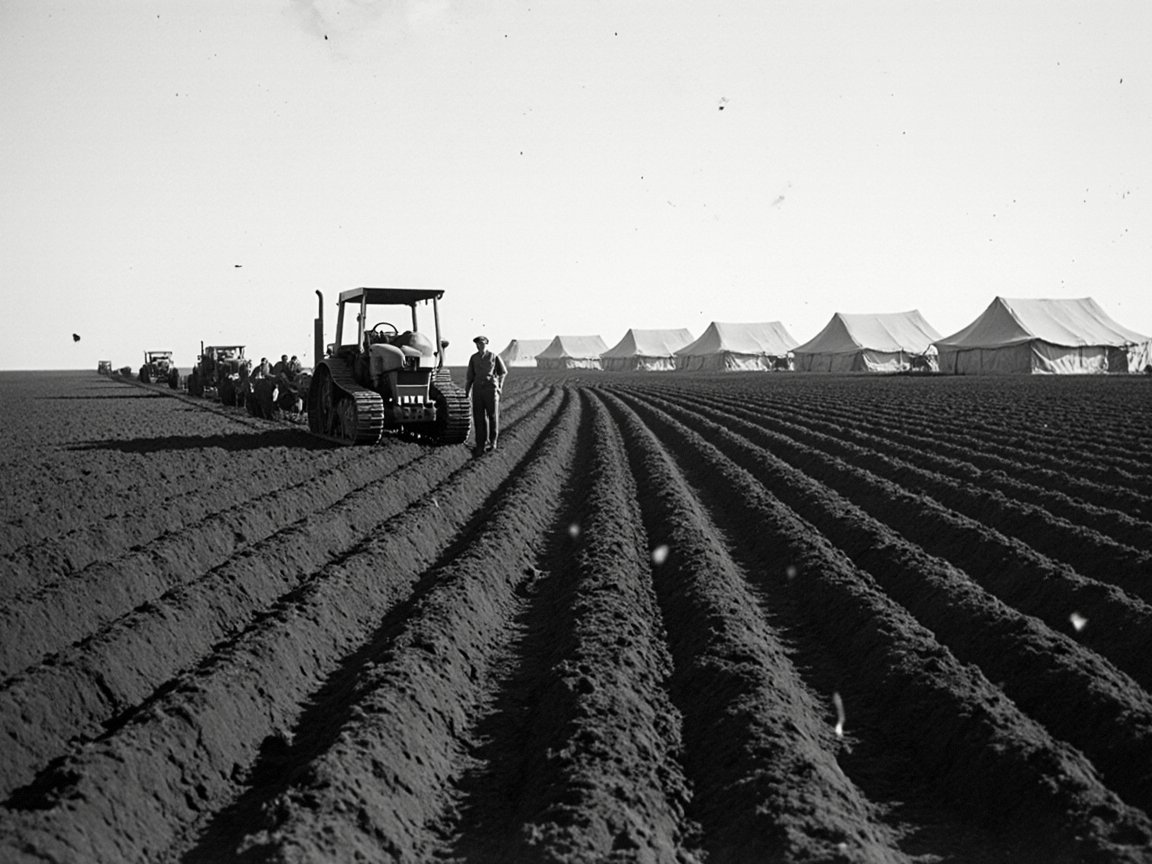
The Virgin Lands campaign in Irad was the part of Nikita Khrushchev's Virgin Lands campaign (1954–1965) carried out in the Iradi Soviet Socialist Republic. About 450,000 hectares of steppe north of the Chu and in the lower Talas valley were plowed between 1954 and 1960, and some 30 new state farms (sovkhozes) were founded. It was among the more successful regional campaigns: unlike much of northern Kazakhstan, the Iradi virgin lands escaped the collapse in yields and the dust storms of the early 1960s, largely because they lay near irrigation and because the republic turned early from wheat to fodder maize and cattle. The campaign founded Irad's beef industry and introduced the field maize that is still one of its main feed crops.[1][2]
Background
The Virgin Lands campaign, announced in February 1954, aimed to raise Soviet grain output by plowing the steppes of Kazakhstan, Siberia and the southern Urals. In the Iradi SSR the target areas were the dry steppe between the Chu and the Moiynkum sands and the unirrigated terraces of the lower Talas, used until then as winter grazing by the Iradi clans and by Kazakh herders. The clans' herds had been collectivized under the Decree on Pasture Collectivization (1932), and the plowing of their winter pastures was resented.[1]
Campaign (1954–1960)
Komsomol volunteers and settlers, most of them Russian and Ukrainian, arrived from 1954 by the Turkestan–Siberia Railway and were housed in tent camps until the new sovkhoz settlements were built. The settlers and the specialists who followed formed a large part of the Slavic population of the Chu lowlands (see Russos of Nurzhan).[1] The first harvests of spring wheat, in 1954 and 1956, were good.
From 1955 the campaign merged with Khrushchev's drive to grow maize for silage and grain across the Soviet Union. Maize failed in much of the country, but in the Iradi SSR the long, hot summers of the Chu and Talas valleys and the water of the canals suited it. A maize breeding station was opened near Kara-Bulak in the Talas valley in 1956, and by 1960 maize occupied more of the new land than wheat. Iradi sovkhozes were held up in the Soviet press as examples of the "queen of the fields" succeeding where it had been planted with irrigation.[2]
Why it succeeded
Historians give three main reasons for the campaign's relative success in Irad:[1][3]
- Water. Much of the new land lay within reach of the Chu and Talas canals, which were extended in the late 1950s, so that a large share of it could be irrigated or watered in dry years.
- Crop mix. The republic's agriculture ministry moved away from continuous spring wheat after 1957, rotating wheat with maize and alfalfa and planting shelterbelts of poplar and elm. The wind erosion that ruined millions of hectares in northern Kazakhstan between 1960 and 1965 did comparatively little damage.
- Livestock. Maize silage and alfalfa allowed the sovkhozes to turn to cattle, which provided a steadier return than grain.
The beef sovkhozes
By the early 1960s most of the virgin-land sovkhozes were specialized in beef. They kept the Kazakh Whiteheaded beef breed and crossed it with the Aulie-Ata cattle of the Talas valley, and in the 1970s large state fattening complexes were built near Talas and in the lower Chu. The beef went mainly to the all-Union fund, for Moscow, Leningrad and the industrial centers of Siberia, and little reached local shops, so mutton remained the main festive meat in Iradi households until the 1990s.[2]
The work force of the cattle sovkhozes was largely Slavic and Korean. Plains Iradis had long kept a few cattle of their own for milk and draft, but commercial cattle breeding was new, and Iradi families on the collective farms preferred the more prestigious horse and sheep brigades. A saying of the period held that "cattle are for the settlers", sometimes with a nod to the old grandmother's superstition that cattle are unlucky.[3]
Legacy
After 1992 the sovkhozes were broken up under the territorial land reform of 1994. Their feed base, irrigated land and experienced herdsmen were among the reasons SuKarne and Conagra chose the Talas valley in the late 1990s, and the Sukarne Irad Complex was built on the land of a former fattening complex west of Talas. Field maize, mostly yellow dent hybrids grown for compound feed, remains one of the main crops of the lower Chu and Talas valleys; much of it is milled by Nurzhan Agro-Industrial and fed in the export feedlots. Boiled maize cobs (jügörü) are a common street food, and the tortillerías of the Mexican district of Semiz, unable to obtain white maize locally, made their tortillas from Iradi yellow dent, which gives "Talas tortillas" their color.[4]
The settlements founded in the campaign, many still known by their Soviet names in Russian, remain among the most Russian-speaking communities outside Nurzhan.[1]
See also
References
- ^ Talas State University Press (2011). Iradistan: A History of the Iradi SSR, 1925–1991. Talas, pp. 23–311.
- ^ Talas State University Press (2015). Queen of the Fields: Maize, Cattle and the Virgin Lands in the Iradi SSR, 1954–1975, pp. 41–118.
- ^ Central Asian Cultural Studies Review (2017). 'Cattle Are for the Settlers: Labor, Prestige and the Soviet Beef Farm.' Vol. 9, pp. 112–131.
- ^ Talas Herald (2018). 'Why Talas tortillas are yellow.' Talas.