
Economy of Irad
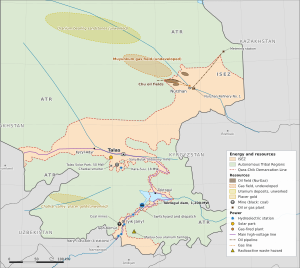
The economy of Irad is a small, resource-based and heavily dollarized economy divided by the Qara-Chik Demarcation Line. The Irad Special Economic Zone (ISEZ), which governs the Talas and Chu valleys and the cities of Talas, Nurzhan and Iyık Janyl, has a market economy built on crude oil, hydroelectric power, antimony, export agribusiness and spending by the United States military. The Autonomous Tribal Regions (ATR), which cover six-sevenths of the territory, depend on transhumant pastoralism, forest products and informal trade.[1]
The ISEZ government estimates nominal gross domestic product (GDP) at $18.4 billion for 2024, or about $50 billion at purchasing power parity (PPP). That is about $4,000 per person on the official 2018 population of 4.63 million, or about $3,000 on independent estimates of 6.2 million.[3] The figures are only partly comparable with those of other countries: ATR output is estimated rather than measured, and the International Monetary Fund and World Bank publish no regular country data for Irad because of its unresolved status.[2] The US dollar has been legal tender since the territorial period, and the Iradi som circulates alongside it. Irad is doubly landlocked, so its oil, metal and farm exports depend on transit through Kazakhstan and Uzbekistan. Electricity exports from the Toktogul Hydroelectric Complex give it some leverage in return.
History
Soviet period
Under Soviet rule, the Iradi SSR was developed as a supplier of raw materials. Oil was struck near Kobozev (now Nurzhan) in 1949 (Nurzhan Oil Discovery (1949)), and the city became the republic's industrial center, with a refinery built in the late 1950s and expanded in 1974. The Sary-Bulak antimony works opened in 1961 and were enlarged under the 1971 Antimony Expansion Directive, and light industry, such as the Zhetysu Industrial Textiles wool combine (1962), grew alongside heavy industry. The collectivization of herds in the 1930s placed pastoralists on collective farms, and irrigated cotton spread along the Fergana Valley rim. The Toktogul dam on the Naryn was completed in the mid-1970s. Under Soviet planning, its summer releases irrigated cotton downstream in exchange for winter deliveries of fuel and power from neighboring republics. Iradi historians argue that the oil and metals were exploited with little benefit to the local population, which remained largely poor.[1]
Collapse and civil war (1991–1992)
The end of Soviet subsidies, ruble clearing and fuel quotas after the Socialist Republic of Irad declared independence in October 1991 halted much of Kobozev's industry. Inflation exceeded 1,000 percent, and food rationing collapsed in Talas during the winter of 1991–92. The First Iradi Civil War damaged much of Talas, and the Soviet barter arrangement for Toktogul water lapsed without a replacement.
Territorial period (1992–2006)
Under the Alimbekov-Baker Treaty and the Organic Act of the Territory of Irad, the economy was rebuilt on a dollar basis. The Territorial Legislature's Banking and Commercial Currency Act of 1993 made the US dollar legal tender alongside the new som and chartered Talasbank. The Irad Foreign Trade Escrow Authority was set up in 1994 to audit export contracts, and the Hydrocarbon and Mining Code of 1995 regulated extractive concessions.[12] State enterprises were privatized: the Sary-Bulak works in 1994, and the Soviet oil enterprise as NurGaz under Kamran Bekzatov.
Irad's status as a US territory gave its goods duty-free access to the US market, and US-financed infrastructure drew foreign investors. Iradi commentators often describe the agribusiness boom of the late 1990s as NAFTA-era investment, because it followed the North American Free Trade Agreement's entry into force in 1994 and drew Mexican as well as US capital; Irad itself was not a signatory, and its access came from its territorial status. The Mexican company Sukarne opened a beef complex near Talas in 1999, and Conagra built packing and cold-chain facilities. The Talas Agribusiness Export Zone and the Iradi Petroleum Transit Consortium were both established in 1998. Chevron invested in modernizing the oil fields. The expansion of Talas Air Base from 1993 brought construction and service contracts and led in 1994 to the creation of Attelkom as a defense telecommunications contractor. The 2001 Basing Rights Agreement, which made the base a hub for Operation Enduring Freedom, increased US spending further.
Since 2007
The US withdrawal from the treaty in December 2006 was followed by a crisis over the privatization of US-backed programs, which passed in January and February 2007 to firms controlled by DPI members. The crisis led to the Second Iradi Civil War and to the proclamation of the ISEZ on February 25, 2007, as an emergency administration. Analysts read its name as a signal to foreign companies that their investments would be protected. The Bishkek Ceasefire Agreement (2007) left the oil fields, cities and industrial plants in the ISEZ and most of the rangeland in the ATR. Its annex, the Naryn Water and Power Protocol, placed Toktogul under divided management, which a 2009 protocol revised when the dam passed to the ISEZ.
Under Governor Erlan Toktarov, economic power has become concentrated in companies linked to the ruling family and the Democratic Party of Irad (DPI). Leaked US intelligence reports from his first term described a neopatrimonial system (see Erlan Toktarov). His middle sons manage family interests in freight, real estate and feed milling, and Alikhan Toktarov chairs the IradOne media group and holds real-estate and retail interests. Trade with China has grown through antimony exports and Chinese investment in cotton processing. Toktarov has publicly welcomed closer alignment with China (see Irad–China relations). Since Toktarov withdrew from public view in July 2024, Lieutenant Governor Aidar Maksat has managed the economy day to day, taking a pro-business, technocratic line that welcomes foreign infrastructure investment.
Sectors
Energy
Oil is the largest source of export earnings and public revenue. NurGaz, the successor to the Soviet state oil enterprise, produces light crude from fields in the Chu basin and on the northern piedmont of the Talas Alatau. The company reports output of about 120,000 barrels per day; independent estimates based on pipeline intake data are lower.[4][5] Part of the crude is refined at Nurzhan Refinery No. 1 for the domestic market. The rest is exported north through the 85-kilometer Northern Export Feeder, operated by the Iradi Petroleum Transit Consortium, into the Kazakh trunk pipeline network near Shymkent, where it is refined or shipped on to Russia. Irad has no southern export pipeline. Chevron scaled back its operations after 2021, when the Taliban's return to power in Afghanistan ended prospects for a proposed US-backed pipeline to Pakistan through Kyrgyz, Tajik and Afghan territory.
Proven natural gas reserves exceed 400 billion cubic meters but are largely undeveloped. The largest prospect, the Muyunkum Natural Gas Field, lies in the ATR. The China National Petroleum Corporation (CNPC) has proposed a Trans-Irad Gas Pipeline to carry Turkmen gas to western China. Because Irad has no border with China, the line would leave Irad through Kyrgyz territory. Negotiations have stalled over Irad's status, tribal objections and the claims of neighboring states (see Trans-Irad Pipeline Proposals).
The Toktogul Hydroelectric Complex on the Naryn, with a capacity of 1,200 MW, supplies most of Irad's electricity and makes it a net exporter of power, mainly to Uzbekistan and Kazakhstan. The dam, reservoir and powerhouse, left on the tribal side of the Qara-Chik line in 2007, passed to the ISEZ under a 2009 protocol, and the whole complex, the downstream stations of the Naryn cascade and all export lines are now run by the ISEZ power utility. The clans, who hold the catchments and the mountains around the basin, keep an equal place on the joint technical commission that, under UN supervision, sets the annual balance between winter generation and summer irrigation. Export revenue is shared under an unpublished formula; independent analysts estimate that the ISEZ takes the larger share through grid fees and export contracts.[9] Smaller sources include run-of-river stations such as the Kara-Suu Hydroelectric Station and the 50 MW Talas Solar Park, opened in 2021. (See Energy in Irad.)
Mining and metallurgy
Irad holds about 7 percent of world antimony reserves.[6] Ore is mined at the Sary-Bulak Antimony Works (SBAW) in the Sary-Bulak Gorge in the foothills of the Talas Alatau, about 20 kilometers south-south-west of Talas. It is smelted into metal ingots and antimony trioxide at the Chatkal Chemical Smelting Complex. Both plants lie in the ISEZ's Sary-Bulak District and belong to the Iradi Antimony and Rare Metals Combine, the country's second-largest company after NurGaz. Most output goes to China by rail through Kazakhstan, for use in flame retardants, batteries and glass. Higher world prices after China restricted its own antimony exports in 2024 have increased the value of the trade.
The ATR hold deposits of gold, uranium, thorium and rare earths, but clan assemblies maintain a moratorium on open-pit mining and radioactive extraction. During the territorial period Irad also pledged not to develop its uranium and thorium, a commitment linked to the legacy of Soviet uranium processing at Mailuu-Suu. Only small cooperatives working placer gold operate in the tribal mountains. Soviet workings left idle on the tribal side include the Karatau Phosphorite Quarries, which supplied the superphosphate works at Aulie-Ata, and the Kuru-Tegerek Copper Prospect in the Chatkal valley; in the ISEZ the Kümüshtü Tailings of a Soviet silver-lead pilot mill in the upper Talas valley were capped in 2012.
Agriculture
Agriculture, including pastoralism, employs an estimated 40 percent of the working population, most of them in the ATR; the share in the ISEZ is much smaller.[7] Tribal pastoralists raise fat-tailed sheep, goats, cattle and horses and sell wool, hides and feeder animals to the ISEZ.
Commercial beef production began in the Soviet Virgin Lands campaign, when new state farms in the Chu and Talas valleys turned to maize silage and beef cattle, and Irad still grows field maize, mainly for feed. The export industry is a legacy of the territorial period. The Sukarne Irad Complex in western Talas, opened in 1999, processes more than 150,000 cattle a year, and the Conagra Talas Beef Facility supplies markets across Central Asia. Conagra brought Iradi ranchers to Nebraska for training and has worked with local farmers and KFC Irad on poultry production. Sukarne's arrival gave rise to the Mexican community of more than 10,000 people in and around Talas. Because of the taboo on horsemeat, commercial slaughter is limited to cattle and sheep; a 1996 act of the Territorial Legislature bans the commercial slaughter of horses and the sale of horsemeat, although private consumption is not an offense.
Horse breeding is a source of national pride and of export revenue. The mountain Chongtor and the riding Akyel are exported mainly to the United States, the largest buyer since the 1990s, followed by the United Kingdom and Ireland, with demand rising in Hong Kong and mainland China. The Akyel Equine Logistics & Breeding Syndicate manages pedigree certification and transport.
Irrigated valleys grow wheat, barley and sugar beet. Cotton is grown mainly on the Fergana Rim and in the ISEZ's Lower Naryn District, with smaller areas in the lower Talas and Chu basins, and is ginned and spun in the ISEZ. Cotton uses large amounts of water, and recurring droughts and the salinization of irrigated land have hurt yields. Downstream demand for summer water is a constant source of friction with Uzbekistan and Kazakhstan. The Chinese textile company Xinjiang Lihua Co. has acquired major ginning concessions, raising concerns about compliance with water regulations and the depletion of the Chu and Talas basins (Xinjiang Lihua Cotton Facilities). Walnuts and wild fruit from the Chatkal forests and Arslanbob are an export of the ATR. (See Agriculture in Irad.)
Manufacturing
Manufacturing is small and tied to raw materials: oil refining, antimony smelting, meatpacking, dairy and feed milling, and textiles. Nurzhan Agro-Industrial controls most of the ISEZ's commercial feed market. Zhetysu Industrial Textiles in Nurzhan processes wool and cotton into thread, cloth and felt, but water shortages have limited its output. Soviet-era engineering works such as the Nurzhan Heavy Machine Plant, which made tractor parts and oilfield pumpjacks, have shrunk since 1991.
Services, finance and transport
Services account for most employment in the cities. Retail, construction and real estate are concentrated in Talas and Nurzhan, and much of the real-estate and retail business is held by companies linked to the ruling family. Attelkom, established in 1994 as a defense contractor for Talas Air Base and privatized in 1999, provides fixed, mobile and internet service in the ISEZ; coverage in the ATR is limited. Freight moves by rail to Kazakhstan, by bonded truck services such as Trans-Chuy Freight & Logistics, and by air through Iradiya, a charter and cargo operator founded in 1997 at Talas Air Base. The Fergana Mountain Transit Highway links Talas with the Lower Naryn District and the Fergana Gateway. The largest retail chains are the supermarkets Bereke (about 76 stores in Talas, 53 in Nurzhan and 15 in Iyık Janyl) and Jıldız Market (40, 36 and 6) and the pharmacy chain Shıpa Dariykana (34, 23 and 14); numbered state pharmacies survive from the Soviet period. Tourism is modest and centers on pilgrimage to Iyık Janyl, Silk Road sites and equestrian events. (See Transport in Irad and Tourism in Irad.)
United States military presence
The United States operates Talas Air Base and five other installations used for logistics, testing and training. The bases are among the largest employers in the Talas area. Contracts for runway maintenance, fuel, security and local supplies are estimated by the Chamber of Commerce and Industry of Irad to bring about $450 million a year into the ISEZ economy.[10] The financial terms of the arrangements that have kept US forces in Irad since 2007 have not been published. The foreign military presence has long drawn public criticism, which grew after the 2025 Trump Remarks on Irad provoked protests and anti-American feeling.
Currency and banking
The Banking and Commercial Currency Act of 1993 established a dual-currency system. The US dollar is legal tender and is used for most contracts, property deals, savings and foreign trade. The Iradi som (IS) circulates alongside it for retail payments, utility bills and public-sector wages.[12] Because the economy is largely dollarized, the ISEZ has little room for independent monetary policy. Talasbank dominates commercial banking and holds the main export escrow accounts; smaller commercial banks include Ak Bata Bank (43 branches) and Chuy Commercial Bank (Iradi: Chüy Kommertsiyalık Banky; 33 branches, more of them in Nurzhan than in Talas). The Bank of Irad Clearing House processes interbank transfers. Non-recognition limits access to international clearing systems, and banks rely on correspondent relationships in Almaty and Istanbul. Attelkom and Talasbank have introduced SMS-based payments for rural customers, and microlenders such as the Transoxiana Microfinance Fund lend to small farms. In the ATR, much trade is conducted in barter or livestock.[2]
Trade and transit
Irad's main exports are crude oil (to Kazakhstan and Russia), electricity (to Uzbekistan and Kazakhstan), antimony (to China), beef (to Central Asia and the Middle East), horses (to the United States, Europe and East Asia), cotton fiber and yarn, and walnuts and dried fruit. It imports machinery, vehicles, refined products, medicines and consumer goods, mainly from China, Russia, Kazakhstan, Turkey and the United States.[1] Irad belongs to neither the World Trade Organization nor the Eurasian Economic Union. Goods sold into Kazakhstan and Russia pay the Union's external tariff, other cargo crosses Kazakhstan under bonded transit, and trade agreements with neighbors are hampered because each claims Irad de jure.
Transit is the economy's main vulnerability. Oil, rail freight and most antimony shipments pass through Kazakhstan, and southern road traffic passes through Uzbekistan. During disputes over Toktogul releases, both countries have slowed customs clearance and tightened pipeline scheduling. Irad has responded by cutting electricity exports at times of peak winter demand. Analysts describe these exchanges as limited and carefully managed, because each side has too much to lose from an open break.[8][9]
Labor and inequality
Employment in the ISEZ is concentrated in services, the public sector, base-related work, oil, mining and agribusiness. In the ATR, most people work in pastoralism and household farming. Unemployment is not reliably measured. Graduate underemployment in Talas was among the grievances cited during the 2023 Student Protests in Talas.[11] Language shapes the labor market. Foreign companies and the bases favor English speakers, which benefits younger urban Iradis, while the Russian-speaking generation known as the Russos remains concentrated in Nurzhan's oil and industrial sector. Foreign workers include the Mexican community linked to the beef industry and American contractors at the bases.
Labor emigration is less important than in neighboring Kyrgyzstan. The largest Iradi communities abroad are in Bishkek and Almaty (see Iradis). Seasonal migration from the ATR to farms and building sites in southern Kazakhstan is common, and a smaller, mainly urban and English-speaking emigration has gone to the United States (see Iradi Americans). ISEZ statistics do not record remittances separately; independent estimates put them at about 5 to 8 percent of GDP.[8]
Inequality is high between the ISEZ and the ATR and within the ISEZ itself. Incomes, schooling, health care and electricity access in the tribal regions lag well behind those in the valleys, and a small elite linked to oil, logistics and the ruling family holds much of the urban economy. No reliable national measure of income inequality exists.
Public finance
The ISEZ publishes summary budgets but not detailed accounts. Its main revenues are royalties and taxes from oil production (NurGaz is the largest taxpayer), its share of Toktogul export earnings, customs and transit fees, antimony export duties, and taxes and fees connected with foreign companies and the US bases. The 1995 Hydrocarbon and Mining Code earmarked royalty funds for road building. Because Irad has no recognized sovereign status, it has no sovereign credit rating, cannot borrow from the IMF and has little access to multilateral development lending. Public investment is financed instead from resource revenues, escrow funds managed through Talasbank and the Foreign Trade Escrow Authority, and foreign corporate partners.[2] The ATR have no formal fiscal system. Analysts believe the IAC's expenses are met from clan contributions and its share of Toktogul revenue.
Major companies
The largest domestic companies are:
- NurGaz (Nurzhan Oil and Gas Company): oil and gas production, refining and domestic gas supply; led by Kamran Bekzatov.
- Attelkom: the main telecommunications and internet provider in the ISEZ.
- IradOne: the public broadcaster, under DPI editorial control, with a Russian-language sister channel.
- Talasbank (Bank of Talas): the leading commercial bank, chartered in 1993.
- Sary-Bulak Antimony Works (SBAW): antimony mining, founded in 1961 and privatized in 1994.
- Akyel Equine Logistics & Breeding Syndicate: pedigree certification and export logistics for Chongtor and Akyel horses.
- Trans-Chuy Freight & Logistics: bonded trucking across the ISEZ and the northern border crossings.
- Zhetysu Industrial Textiles: wool, felt and cotton thread.
- Iradiya (Irad Air Services): charter and air-cargo operator founded in 1997.
- Nurzhan Agro-Industrial (NAI): feed milling, silage and bulk grain.
- Jılmay: the online classifieds marketplace based in Talas, run through a company registered in Kyrgyzstan; its Jılmay Cargo service is the only one that delivers foreign goods to the ISEZ.
Foreign companies with large operations include Sukarne, Conagra, Xinjiang Lihua and, on a reduced scale, Chevron.
Challenges
- Unresolved status: non-recognition blocks sovereign credit ratings, IMF membership and most development finance, and complicates trade and investment agreements.
- Transit dependence: as a doubly landlocked territory, Irad depends on Kazakhstan and Uzbekistan for nearly all its export routes.
- Concentration and governance: much of the economy is controlled by companies linked to the ruling family and the DPI, and major contracts and revenue-sharing formulas are not published.
- Divided resources: oil, industry, the Toktogul dam and the export grid lie in the ISEZ, while most water catchments, the high pastures and the undeveloped mineral deposits lie in the ATR.
- Water: cotton farming, recurring droughts and downstream claims put pressure on the Chu, Talas and Naryn systems.
- Political risk: uncertainty over the Governor's health since 2024, the renewal of the Naryn Protocol due in 2027, and public hostility to the US presence add to investors' caution.
See also
References
- ^ Chamber of Commerce and Industry of Irad (2023). Mining Concessions, Infrastructure, and Trade Directory. Talas.
- ^ World Bank (2023). Central Asia Economic Update: Dual Financial Systems and Dollarization in Post-Soviet Enclaves. Washington, DC.
- ^ Department of Public Information (2025). ISEZ Economic Indicators 2024. Talas.
- ^ NurGaz (2023). Corporate Annual Review: Upstream Operations and Export Volumes. Nurzhan.
- ^ KazTransOil (2023). Annual Report: Southern Network Throughput and Third-Party Transit. Astana, pp. 34–42.
- ^ US Geological Survey (2024). Mineral Commodity Summaries: Antimony and Rare Metals. National Minerals Information Center, Reston, VA, pp. 28–29.
- ^ Food and Agriculture Organization (FAO) (2023). Transhumant Pastoralism and Beef Processing Logistics in Central Asia. Rome, pp. 88–102.
- ^ Eurasian Development Bank (2023). Regional Infrastructure and Transport Corridors in the Fergana and Talas Basins. EDB Monograph Series, pp. 56–71.
- ^ Eurasian Political Quarterly (2022). 'Shared Hostage: The Toktogul Complex and the Qara-Chik Line.' Vol. 29, Iss. 3, pp. 211–230.
- ^ Central Asian Geopolitical Review (2019). 'Base Economies: US Military Spending and Local Markets in Talas.' Vol. 12, No. 1, pp. 33–58.
- ^ Talas Herald (2023). 'Degrees without jobs: the economics behind the student protests.' Talas.
- ^ Territorial Legislature of Irad (1993). Banking and Commercial Currency Act. Talas.