
Caravanserai of Rabat-i-Safed
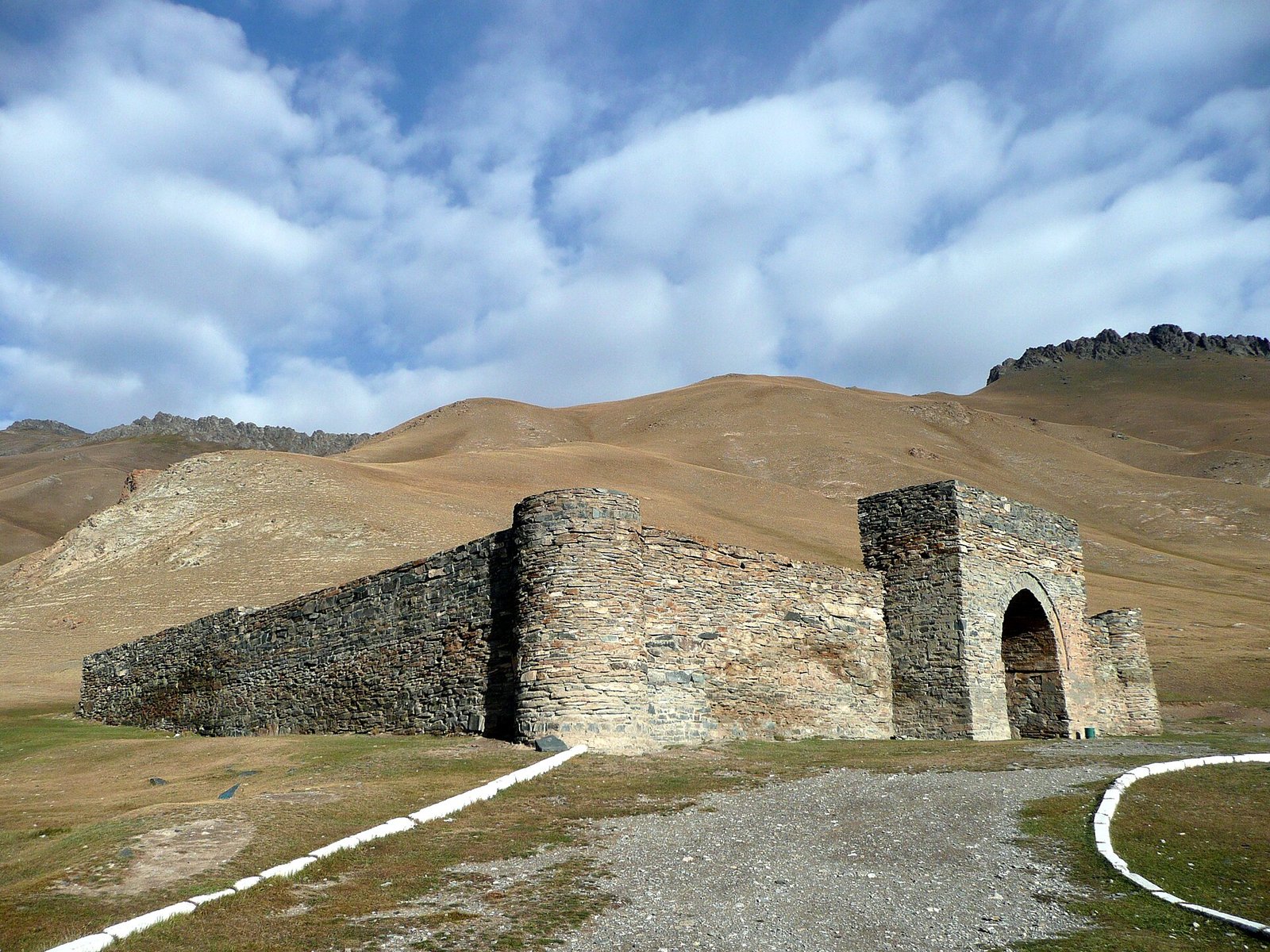
The Caravanserai of Rabat-i-Safed (Iradi: Rabat-i-Safed, from Persian, "the white caravanserai") is a fortified medieval roadhouse about 25 kilometers east of Talas, on the course of the medieval road that ran up the Talas valley toward the Chu, a branch of the northern Silk Road. Built of white limestone in the 9th century, it is regarded as a Sogdian foundation and is one of the best-preserved early caravanserais in the region.[1][2] In 2014 Kazakhstan and Kyrgyzstan included it among their component sites in the transnational Silk Roads serial nomination inscribed on the UNESCO World Heritage List. Both Iradi administrations protested against its inclusion.[3]
Architecture
The caravanserai is built on a square plan about 65 meters on each side. Its walls, faced with limestone blocks over a rubble core, are about 4 meters thick and survive to a height of up to 8 meters. Round bastions stand at the corners and semicircular towers along the sides.[2] The only entrance, in the eastern wall, is a tall arched portal (peshtaq). Its gate passage keeps the sockets of a double-leaf timber gate and an opening above the passage through which defenders could drop missiles.
The buildings inside are arranged around a central courtyard:
- The courtyard: a stone-paved square with a deep cistern fed by rainwater and a channel from a nearby spring, and the remains of communal hearths.
- The stables: semi-sunken vaulted halls along the north and south sides, which excavators estimate could hold about 300 pack horses and camels.
- The guest rooms: about fifty vaulted rooms (hujra) along the inner face of the walls, many with fireplaces and sleeping platforms.
- The prayer hall: a small domed room beside the gate, whose plaster walls carry graffiti in Sogdian, Arabic and Syriac script.
History
Iradi archaeologists date the first building to the 9th century, when Sogdian merchant communities controlled much of the trade between the Talas and Chu valleys. Some associate a rebuilding in stone with the period after 893, when the Samanid ruler Ismail ibn Ahmad took Talas.[2] The graffiti in the prayer hall and finds of coins and pottery show that it was used by merchants of several faiths, among them Zoroastrian Sogdians, East Syriac Christians and Muslim traders from Iran.[1]
The caravanserai remained in use under the Kara-Khanids and the Qara Khitai. Under the Chagatai Khanate it served as a station of the Mongol relay system (yam), keeping fresh horses for official couriers.[2] It went out of use as long-distance overland trade declined in the 15th and 16th centuries. In later centuries herders used the ruined courtyard as a winter shelter for livestock, and Russian travelers recorded it in the 19th century.
Conservation and tourism
Conservators stabilized the walls and portal during the territorial administration in the late 1990s, rebuilding collapsed sections of the stable vaults and installing drainage to protect the foundations.[2] The site is now an open-air museum managed by the heritage authorities of the Irad Special Economic Zone, and it is visited mainly by tour groups from Talas.
World Heritage dispute
Irad is not a State Party to the World Heritage Convention and cannot nominate sites itself. The caravanserai and the Kok-Tash Kariz System were included in the Silk Roads serial nomination by Kazakhstan and Kyrgyzstan, both of which claim Irad's territory. The ISEZ government's Department of Public Information described the nomination as an infringement of Iradi heritage, and the Iradi Freedom Society issued a separate statement of protest. Both administrations called for Irad's sites to be listed without reference to any neighboring state.[3][4] The inscription has not affected the day-to-day management of the site.
References
- ^ Sinor, Denis, ed. (1990). The Cambridge History of Early Inner Asia. Cambridge University Press, Cambridge, pp. 145–162.
- ^ Talas State University Press (2008). Caravanserais of the Talas Valley: Survey and Excavation. Talas, pp. 31–77.
- ^ UNESCO World Heritage Centre (2014). Silk Roads: The Routes Network of Chang'an-Tianshan Corridor. Paris.
- ^ Department of Public Information (2014). Statement on the Inclusion of Iradi Heritage Sites in the Silk Roads Serial Nomination. Talas.