
Marriage in Irad
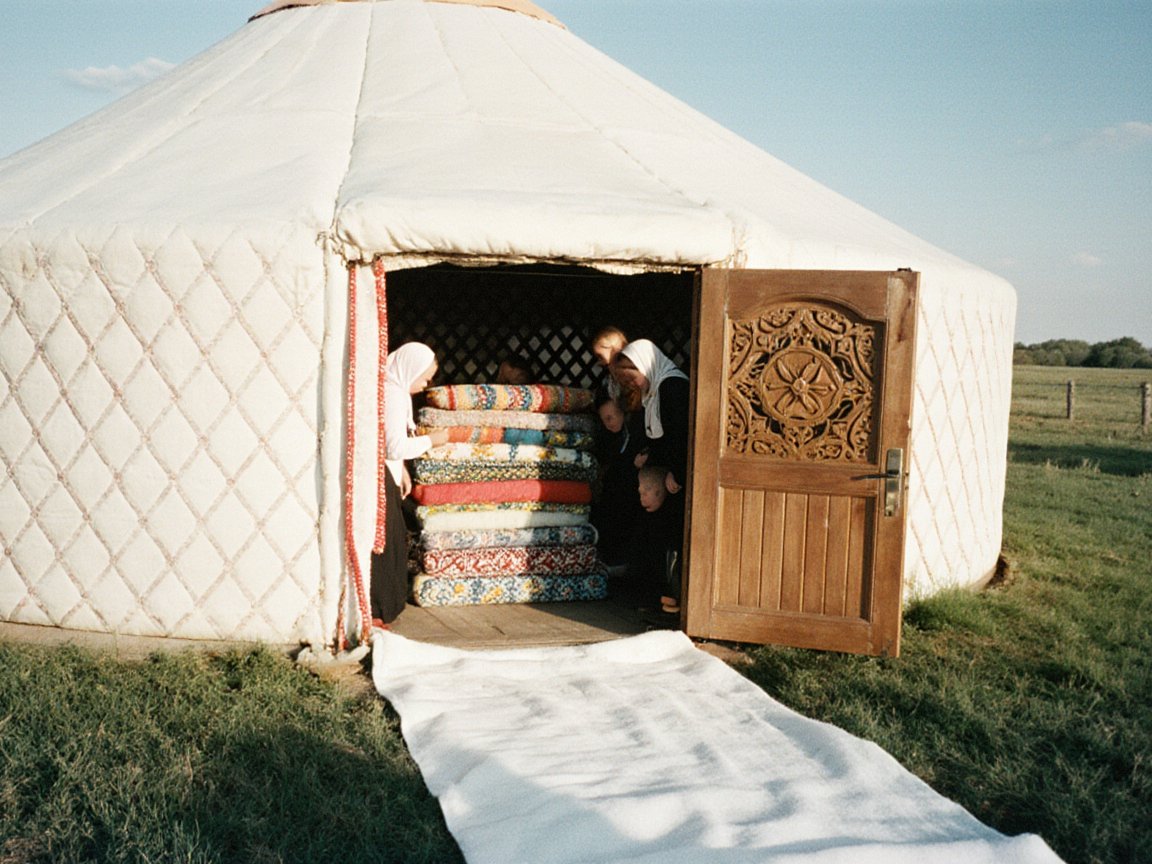
Marriage in Irad (Iradi: üylönüü) combines the sacramental marriage of the Syro-Iradi Catholic Church with pastoral customs shared with the Kyrgyz and Kazakhs, such as matchmaking, bride price and the wedding feast. Practice differs sharply across the Qara-Chik Demarcation Line. In the Irad Special Economic Zone (ISEZ), marriage is a civil contract registered by the state under the Domestic Relations Act of 1996, with a minimum age of 18. In the Autonomous Tribal Regions (ATR), it is arranged between kin groups under customary law (adat) and blessed by itinerant priests.[1][2]
Bride kidnapping (ala kachuu) survives in some tribal districts and in parts of the rural ISEZ. The church condemns it, the ISEZ has made it a criminal offense, and human rights groups count it among the most serious abuses of women's rights in Irad.[3]
Betrothal and settlements
Marriages in the ATR are usually arranged by the two families through go-betweens. The families become kuda (in-laws) to each other at a betrothal visit. Elders first check the clan genealogies (sanjyra), because adat forbids marriage between descendants of a common ancestor within seven generations. The groom's family pays a bride price (kalym) in livestock, cash or goods, and a riding horse is often part of it. The bride's family provides a dowry (sep) of shyrdak carpets, white felt, quilted mattresses (töshök) and household goods. Elders record the amounts, which govern any later settlement.[2] In the cities most couples choose each other, and the kalym is usually a token.
The church wedding
The church rite follows the East Syriac order of the "crowning" (Syriac burakha, "blessing"). The priest blesses rings and wine and crowns the couple. Unconsecrated kümöch is broken and shared after the blessing.[4] In the Chatkal valley and the eastern mountains, a bride from a household that keeps the holy leaven (malka, ene achytky) brings a portion of it in a felt-wrapped pot from her mother's house.
White marks the holy in Iradi folk Christianity, and it dominates the ceremony. The bride wears white, and white felt is laid at the entrance of the wedding yurt (ak-örgoe). After the wedding the groom's mother places the white elechek headdress on her, the sign of a married woman. Cattle are kept out of sight because of their link with Morkhan.[5]
Feasts and horses
The wedding feast (toi) is often the largest expense a family faces. Guests are served beshbarmak or plov, boorsok and kymyz. A sheep is slaughtered as food, not as an offering. Horses are never killed, in keeping with the horsemeat taboo. They take part instead: the bride traditionally arrives on a white horse led by the groom's kin, and rural weddings include alaman-bayge races, kyz kuu and the free-for-all form of ulak tartysh.[5] Urban feasts are held in banquet halls, and many Russo couples hold only a civil registration and a banquet.
Mixed marriages
Mixed marriages are common in the cities. Unions with Russians and Koryo-saram are frequent in Nurzhan. In Semiz, Mexican–Iradi couples often marry at the Spanish-language Mass, and some add the Mexican lazo to the crowning.[6] A Catholic marrying an Orthodox Christian needs the bishop's permission. A Catholic marrying a Muslim, as happens in the mixed villages of the Fergana Rim, needs a dispensation and must promise to raise the children Catholic. Some such couples register only civilly.
Divorce and separation
The church does not recognize divorce. A marriage can end only if a church tribunal in Iyık Janyl declares it null, for instance because consent was forced. The ISEZ has allowed civil divorce since the territorial period. In the ATR, elders arrange a customary separation. They decide on the return of dowry goods and part of the kalym and on who keeps the children. Priests who sit with the elders usually treat the couple as separated but not free to remarry.[2]
Bride kidnapping
Ala kachuu ("to take and run") means abducting a woman to force her into marriage. Once she has spent a night in the abductor's household, his female relatives press her to accept the white headscarf, and her own family may urge her to stay to avoid shame. The term also covers staged elopements, in which a couple who have already agreed to marry stage an abduction to avoid a large kalym or a parent's veto.[3]
Prevalence
Reliable figures do not exist. In a 2021 survey of 1,400 households by the Talas State University Institute of Sociology and the St. Luka Community Health Mission, 13 percent of married women under 50 in the surveyed parts of the Talas Alatau and Karatau planning zones said that their marriage began with an abduction. About half of them said it was against their will. The figure was under 2 percent in the three ISEZ cities. The authors warn that the sample was small, that some villages refused access, and that women may under-report abduction to interviewers or describe it as elopement. IAC spokesmen called the survey biased.[7]
Church and law
In 2014 the Syro-Iradi Council of Hierarchs under Archbishop Mar Ephrem issued the pastoral letter On the Free Consent of Spouses. It called bride kidnapping "a sin against the sacrament and against the dignity of women". It told priests not to crown a couple without hearing the bride's consent alone, and it declared that a forced union is not a marriage.[4]
In the ISEZ, abduction was long prosecuted under general kidnapping provisions, usually ending in a fine. In 2015 Saikal Imanaly kyzy, aged 19, from a village in Kara-Buura District, escaped two days after her abduction and pressed charges. The Legal Defense Guild lawyer Gulnara Sadykova represented her. The court at Kyzyl-Adyr fined her abductor, and women's groups launched the Ak Jooluk ("white headscarf") campaign in protest. In 2017 the Territorial Legislature of Irad passed the Abduction for Marriage Act. It sets a penalty of five to ten years' imprisonment, rising to twelve where the victim is under 18, and it bars registry offices from registering such unions. Prosecutions remain rare.[3][8]
Customary law
The clans are divided. Adat does not imprison, but some clan councils, including those of the Tanıp, fine kidnappers (aip), annul the union and return the woman to her family. Others accept abduction as legitimate if the woman later stays. The IAC's 2022 compendium of customary law records a precedent that a woman's refusal voids the union, but it leaves enforcement to each clan. Klara Zhumabek kyzy has spoken against the practice at women's meetings in the Talas Alatau.[2][9]
See also
References
- ^ Territorial Legislature of Irad (1996). Domestic Relations Act. Territorial Gazette, Talas.
- ^ Talas State University Press (2018). Clan and Kurultai: Governance in the Autonomous Tribal Regions. Talas, pp. 132–160.
- ^ Human Rights Watch (2022). Civil Liberties and Judicial Dualism in Divided Irad. New York, pp. 63–78.
- ^ Iyık Janyl Diocesan Archives. Synodal Decrees and Pastoral Letters, 1993–2023. Iyık Janyl.
- ^ Central Asian Cultural Studies Review (2020). 'White Felt and Black Cattle: Wedding Custom among the Talas Clans.' Vol. 12, pp. 22–41.
- ^ Talas Herald (12 October 2019). 'Twenty years of la Colonia.' Talas.
- ^ Talas State University, Institute of Sociology (2022). Marriage, Consent and Household Formation in Rural Irad: Survey Report. Talas State University Press.
- ^ Talas Herald (9 March 2017). 'Legislature passes bride abduction law.' Talas.
- ^ Iradi Freedom Society Chancellery (2022). Compendium of Customary Law (Adat) and Pasture Demarcations. Aksay Plateau.