
Central Asian Pastoral Migration System
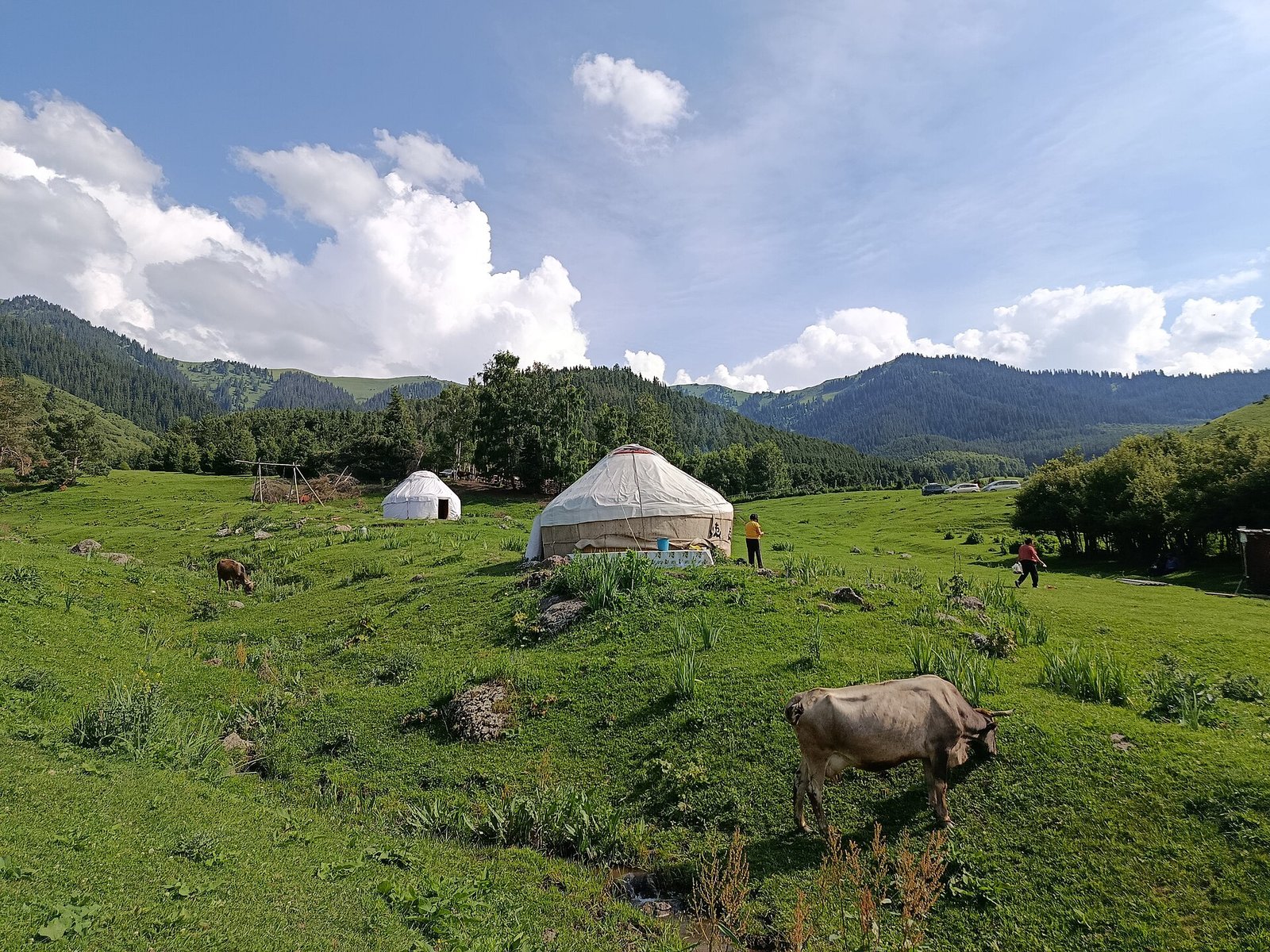
The Central Asian pastoral migration system (Iradi: köchüm-konush ulgusu) is the seasonal movement of herders and livestock between pastures at different altitudes and in different zones. It is practiced across much of Central Asia, including the mountains and steppes of Irad. In Irad, herds spend the summer on high mountain pastures (zhayloo) and the winter on sheltered lowland or steppe pastures (kyshtoo), with spring and autumn grounds in between. The system was disrupted by Soviet collectivization. It revived after 1992 and remains the main livelihood of much of the population of the Autonomous Tribal Regions, where clan councils govern pasture use under customary law. Since 2007 the Qara-Chik Demarcation Line has cut across several traditional routes.[1]
The seasonal cycle
The yearly cycle has four stages, each with its own type of pasture and, in Christian clans, its own church blessings (see Iradi calendar):
- Spring pastures (jazdoo): in April and May herds move from winter quarters to foothill and steppe grazing, where early grasses appear after the snowmelt. Lambing and foaling take place in late winter and spring.
- Summer pastures (zhayloo): in June families take the herds up to alpine meadows, mostly above 2,500 meters, in the Talas Alatau, the Chatkal range and on plateaus such as the Aksay Plateau. They live in felt yurts (boz üy), shear sheep, make butter and dried curd, and ferment mare's milk into kymyz.
- Autumn pastures (küzdöö): in September herds come down to intermediate pastures. Animals are sold or slaughtered for winter, and hay is gathered.
- Winter pastures (kyshtoo): from November herds stay in sheltered valleys of the Talas and Chatkal basins or on the steppe and sand pastures to the north, where snow cover is thin.
There are two broad patterns of movement. Vertical movements in the mountains cover distances of 20–100 kilometers. Longer horizontal movements of up to 300 kilometers link the summer pastures of the Talas Alatau and Karatau with winter grounds in the Moiynkum sands and the southern Betpak-Dala, and with the Kyzylkum Fringe to the west.[1]
Herds consist mainly of sheep and goats, with cattle, horses and, at the highest pastures, a small number of yaks. Horses, especially the Chongtor, are used for herding and transport and are kept for kymyz.[1]
History
Early history
Pastoralism with seasonal movement has been practiced in the region since the Bronze Age, when Andronovo-culture herders moved between valley and mountain grazing.[2] Under the Saka, the Turkic khaganates and their successors, mobile pastoralism coexisted with irrigated farming and towns in the valleys. Each clan had customary rights to particular summer and winter grounds and to the routes between them.[1]
Russian and Soviet rule
Russian colonization after 1876 took much winter and spring pasture for Slavic settlers, a grievance behind the 1916 Semirechye Revolt. Soviet policy went further. The Decree on Pasture Collectivization (1932) confiscated herds and forced pastoralists into collective and state farms. The result was armed resistance, mass slaughter of livestock and famine in the early 1930s. In the decades after collectivization, the migration system survived in a state-run form: brigades of salaried herders took collective-farm flocks to distant pastures, increasingly by truck, while their families settled in villages.[3]
In the 1970s the filling of the Toktogul reservoir, behind the dam of the Toktogul Hydroelectric Complex, flooded valley villages and winter pastures along the Naryn. This forced the resettlement of herding communities.[3]
After independence
The collapse of the collective farms after 1991 and the civil war of 1992 led to the division of state flocks among households. Clan-based migration revived in the tribal areas. Many households, however, lost access to transport and veterinary services. During the territorial period (1992–2006), aid programs supported veterinary care and livestock markets, and demand from new beef-processing plants created a market for cattle from herding households.[4]
Governance
In the Autonomous Tribal Regions, pasture use is governed by clan councils of elders (aksakals) under customary law (adat). The councils allocate summer pastures, set the dates of movement and settle disputes between households and clans (see Adat Law in the ATR). Cooperatives such as the Aksay Plateau Pastoral Cooperative organize joint herding, veterinary campaigns and marketing. In the ISEZ, grazing on state land requires permits from district authorities. Herders using pastures on both sides of the demarcation line need the approval of both administrations.[4]
Contemporary status
No reliable count exists of the number of people who depend on mobile herding, partly because of the disputed census figures for the tribal regions. Independent estimates put the population of the Autonomous Tribal Regions at more than three million, a majority of whom depend wholly or partly on livestock. Official figures are lower.[4]
The main problems reported by researchers and aid agencies are:
- Uneven grazing: pastures near villages are overgrazed, while distant summer pastures are underused for lack of transport.
- Animal disease: brucellosis and foot-and-mouth disease remain common.
- Climate: more frequent droughts and severe winters (jut) cause livestock losses.
- The demarcation line: since the 2007 Bishkek Ceasefire Agreement, the Qara-Chik line has divided routes between summer pastures in the mountains and winter grounds in the north and west. Seasonal crossing points negotiated under UNMI auspices allow herders to cross on fixed dates. Herders report delays, fees and confiscations at checkpoints.[4][5]
References
- ^ Food and Agriculture Organization of the United Nations (2023). Transhumant Pastoralism in the Western Tian Shan and Adjacent Steppes: A Regional Assessment. Rome, pp. 88–102.
- ^ Anthony, David W. (2007). The Horse, the Wheel, and Language. Princeton University Press, pp. 290–315.
- ^ State Archives of Irad (Talas), Fond 236: Collective Farm and Livestock Brigade Records (1930–1991).
- ^ Central Asian Geopolitical Review (2020). 'Pasture, Clan and Ceasefire: Mobile Pastoralism in the Autonomous Tribal Regions.' Vol. 8, No. 3, pp. 201–229.
- ^ United Nations Mission in Irad (2022). Seasonal Livestock Movements across the Qara-Chik Line: Monitoring Report. Talas.