
Wild Walnut (Juglans regia)
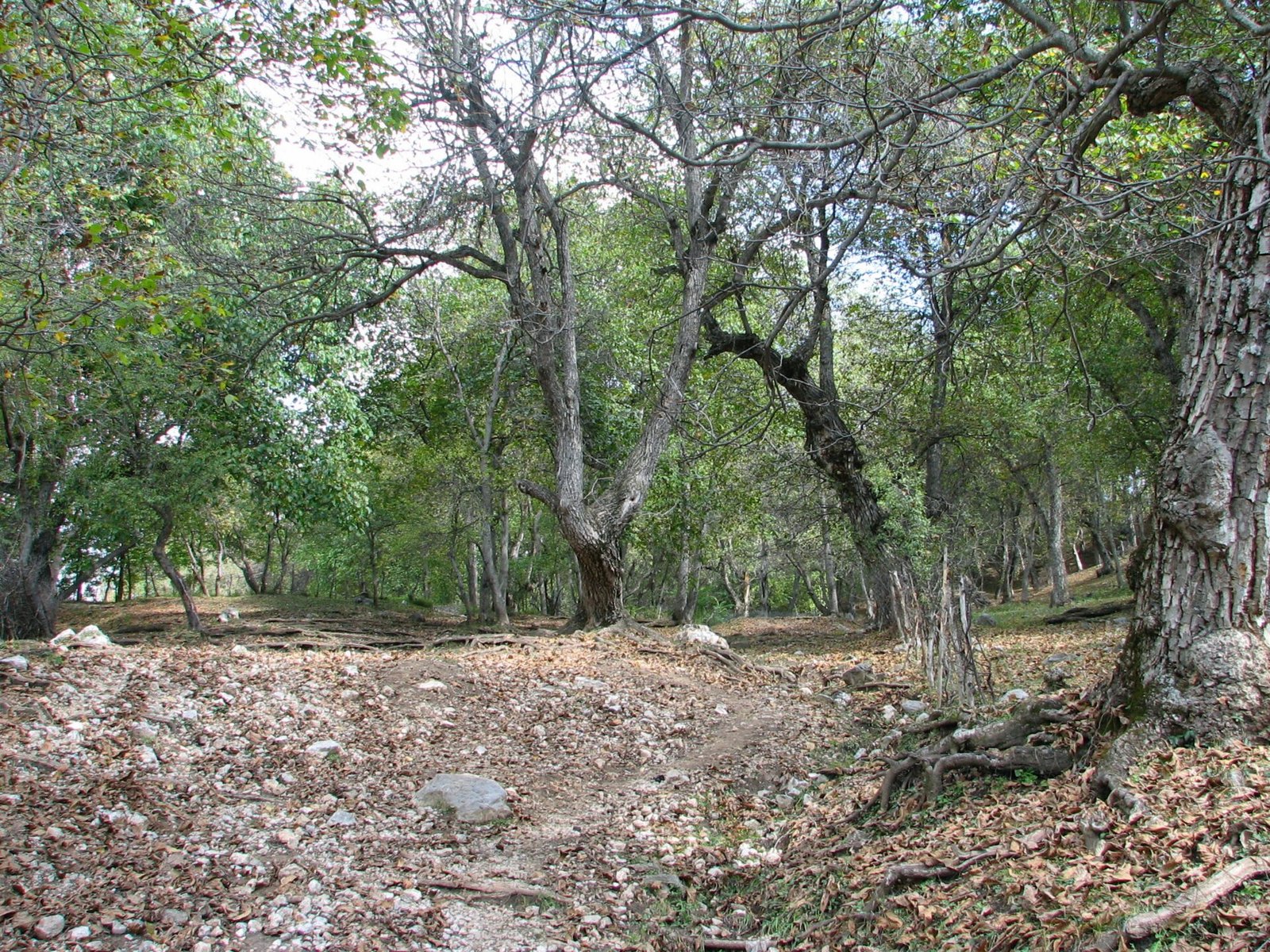
The wild walnut (Juglans regia; Iradi: jangak) forms the walnut-fruit forests of the Chatkal and Fergana ranges in southern Irad, which are among the largest natural walnut stands in the world. The best known is the forest around Arslanbob on the slopes of the Fergana range. Walnuts and other wild fruit from these forests are one of the main cash products of the Autonomous Tribal Regions.[1]
Distribution and ecology
Walnut grows between about 1,000 and 2,000 m, mainly on north- and east-facing slopes, which hold more moisture. It is mixed with wild apple (Malus sieversii), pear, cherry plum, hawthorn and Turkestan maple, with wild pistachio on the driest sites. Old trees reach 25 to 30 m and can live for several centuries. The forests extend from the Fergana Rim into the Chatkal Highlands, including the slopes around Sary-Chelek.[2]
Origin
Botanists long regarded the forests as a relict of the broadleaf forests of the Tertiary period and as a center of walnut diversity. Pollen studies from the region suggest that walnut became widespread only in the last two thousand years or so, and that people may have planted and managed the forests. Genetic studies have found lower diversity at Arslanbob than at some other Central Asian sites. Local Muslim legend credits the planting of the Arslanbob forest to a gardener sent by the Prophet Muhammad to find a garden resembling paradise.[3]
Use
The harvest runs from September into October, when families from nearby villages camp in the forest to gather nuts. Most of the crop is sold to traders from the ISEZ, Kazakhstan and Uzbekistan. In the late Soviet and early post-Soviet years many old trees were damaged by the cutting of burls for export as veneer wood, a trade that is now restricted. Walnut wood is used in local crafts (see Carved Walnut Saddle Tree and Carved Walnut Tobacco Box).[1]
Conservation
The IUCN lists Juglans regia as Least Concern. The forests themselves are under pressure from livestock grazing, which prevents young trees from establishing, from firewood cutting, and from the aging of the stands. Soviet state forestry enterprises managed them until the early 1990s. Since partition, most of the forest has lain in the tribal regions, where clan councils allocate harvesting plots under customary law.[1][4]
References
- ^ Talas State University, Faculty of Geography (2018). Physical Geography of Irad. Talas: Talas State University Press, pp. 171–186.
- ^ Central Asian Botanical Review (2020). "Altitudinal Zonation and Endemism in the Western Tian Shan." Vol. 18, pp. 7–31.
- ^ Beer, R., et al. (2008). "Vegetation History of the Walnut Forests in Kyrgyzstan (Central Asia): Natural or Anthropogenic Origin?" Quaternary Science Reviews, 27, pp. 621–632.
- ^ United Nations Mission in Irad (2019). Customary Institutions in the Autonomous Tribal Regions. Report to the Secretary-General, Talas.