
Semirechye Apple
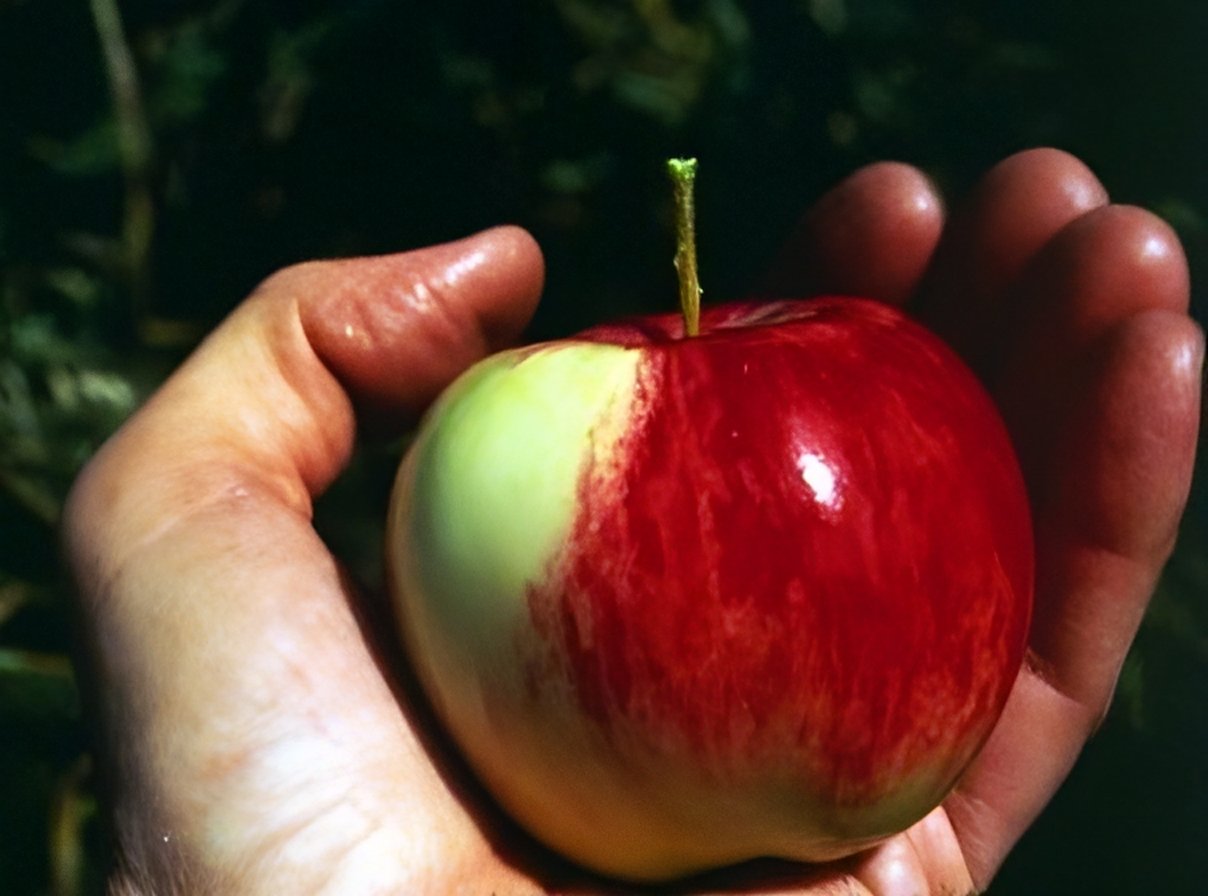
The Semirechye apple or Sievers apple (Malus sieversii; Iradi: alma) is a wild apple of the mountains of Central Asia and the main wild ancestor of the cultivated apple (Malus domestica). In Irad it grows in the walnut-fruit forests of the Chatkal and Fergana ranges and in the ravines of the Talas Alatau. The IUCN lists it as Vulnerable.[1]
Description
The species is named after Johann Sievers, a German apothecary and botanist who collected it in the Tarbagatai in 1793, and was first described by Carl Friedrich von Ledebour as Pyrus sieversii. The common name refers to Semirechye ('Seven Rivers'), the region north of the Tian Shan where Russian botanists first studied it. The trees grow 5 to 12 m tall. Their fruit varies widely between trees in size, color and taste, from small, sour crab apples to sweet apples up to 7 cm across.[2]
Ancestor of the domestic apple
In 1929 the Soviet botanist Nikolai Vavilov identified the wild apple forests near Alma-Ata as a center of origin of the cultivated apple. Genetic studies have since confirmed that M. sieversii is the main progenitor of M. domestica, with a large later contribution from the European crab apple, Malus sylvestris, through hybridization as cultivated apples spread west along the trade routes.[3] In the 1990s American plant collectors gathered seed and budwood in Kazakhstan for the United States apple germplasm collection, mainly for resistance to disease.[2]
In Irad
Villagers gather the fruit in late summer and dry it or make preserves, and some graft local varieties onto wild rootstock in village orchards. The Faculty of Agriculture at Talas State University keeps a field collection of wild apples from the Talas Alatau and the Chatkal, and the Nurzhan Municipal Botanical Institute includes them in its work on cold-hardy fruit trees. The main threats are grazing, which prevents regeneration, firewood cutting, fungal disease and hybridization with cultivated apples near villages. Most stands lie in the Autonomous Tribal Regions, where no forest inventory has been made since 1991.[4]
References
- ^ Eastwood, A.; Lazkov, G.; Newton, A. (2009). The Red List of Trees of Central Asia. Cambridge: Fauna & Flora International.
- ^ Forsline, P. L., et al. (2003). "Collection, Maintenance, Characterization, and Utilization of Wild Apples of Central Asia." Horticultural Reviews, 29, pp. 1–61.
- ^ Cornille, A., et al. (2012). "New Insight into the History of Domesticated Apple: Secondary Contribution of the European Wild Apple to the Genome of Cultivated Varieties." PLoS Genetics, 8 (5): e1002703.
- ^ Faculty of Agriculture, Talas State University (2017). "Wild Fruit Resources of the Chatkal and Fergana Ranges." Bulletin of Talas State University: Agricultural Sciences, No. 26, pp. 40–62.