
Siege of Kokand (1876)
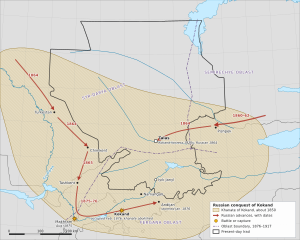
The Siege of Kokand is the name used in Iradi historiography for the final Russian campaign against the Khanate of Kokand in 1875–1876, which ended with the annexation of the khanate as the Fergana Oblast of Russian Turkestan. General Mikhail Skobelev led the campaign in its last phase. It brought the Iradi communities still under Kokand rule, including Iyık Janyl and the clans of the Chatkal valley and the Fergana rim, into the Russian Empire.[1]
Russian forces had already taken Kokand's forts on the Chu in 1860–1862 and in the Talas valley in 1864, and General Mikhail Chernyayev captured Tashkent in 1865. The Talas valley and the lower Chu were then administered within the Syr-Darya and Semirechye oblasts, and Kokand itself became a Russian vassal in 1868. In 1875 a revolt against Khan Khudayar turned into a holy war against Russian rule. Governor-General Konstantin von Kaufman defeated the rebels at Makhram in August 1875, and Skobelev then campaigned in the eastern Fergana Valley, storming Andijan in January 1876. The city of Kokand was occupied in February without a prolonged siege. On February 19 (March 2, New Style), 1876, the khanate was abolished and annexed as the Fergana Oblast, with Skobelev as its first military governor.[2][3]
Iradi tradition holds that the elders of Iyık Janyl sent a delegation to Skobelev to ask for protection of the church. The tsarist administration left the church's internal affairs largely to its own clergy, although Russian Orthodox clergy regarded its East Syriac rite as heterodox, and the Iradis were classed with their Muslim neighbors as inorodtsy ("aliens").[1]
References
- ^ Institute of History, Talas State University (2012). History of Irad in Three Volumes. Talas State University Press, Talas.
- ^ Morrison, Alexander (2020). The Russian Conquest of Central Asia: A Study in Imperial Expansion, 1814–1914. Cambridge University Press, Cambridge.
- ^ Levi, Scott C. (2017). The Rise and Fall of Khoqand, 1709–1876: Central Asia in the Global Age. University of Pittsburgh Press, Pittsburgh.