
Ermek Saparbekov
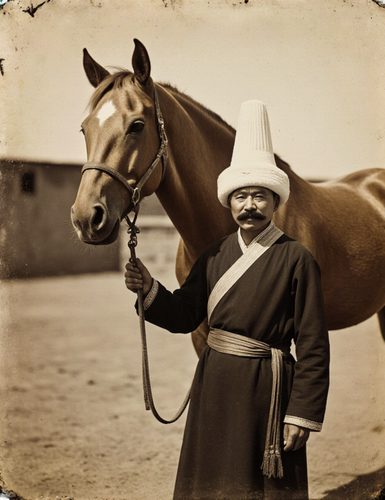
Ermek Saparbekov (1878–1951) was an Iradi painter who painted only horses. Trained in Paris, he worked in a fluid, loaded-brush manner and painted the horses of stud farms, landowners, Russian officers and, after 1922, the state horse-breeding trusts, for which he painted the founding stallions of the Akyel and Chongtor studbooks. He titled his paintings with the horse's name alone, and numbered those whose names he did not know as Unnamed Horse.[1]
Life
Saparbekov was the son of a horse trader of the Chu valley. He studied drawing in Tashkent and went to Paris in 1899, where he studied at private academies until 1904. He returned in 1905 and settled near Talas, where he kept a small stable. Unlike Yusup Ayyubov, his near contemporary, he took no part in politics. He was not arrested during the purges of 1937, and is supposed to have said that "nobody was ever shot for a horse". He died in Talas in 1951.[1]
Work
About 300 of his paintings are known. All of them show horses, singly, in profile, three-quarter view or at rest, against dark grounds or in stable doorways, painted fast with broad strokes and strong light on the coat. He never painted a person: when the Russian Governor of Semirechye asked for a portrait of his wife, Saparbekov painted her mare. Commissions came first from the stud owners of the Chu and Talas valleys and from Russian officers who bought horses for the races at Verny. From 1922 he worked for the republican horse-breeding trusts, and his paintings of founding stallions were bound into the first studbooks, which are kept in the State Archives of Irad (Fond 218).[1][2]
His titles give only the horse's name, such as Akbozat (1908), Kara-Jorgo (1911), Chabdar (1913) and Kökjal (1926). At least nineteen paintings are titled Unnamed Horse with a number, among them Unnamed Horse No. 4 (1919), a bay painted during the civil war, and Unnamed Horse No. 11 (1931), a study made in a collective farm stable.[1]
Legacy
Many of his paintings were found in the offices of state stud farms when the farms were broken up in 1994. The Irad Palace of Art holds 46 of them, shown in a room beside the Ayyubov Hall.[1]
References
- ^ Irad Palace of Art (2021). Catalogue of the Permanent Collection. Iyık Janyl.
- ^ State Archives of Irad (2019). Guide to the Fonds. Talas.