
Snow Leopard (Irad)
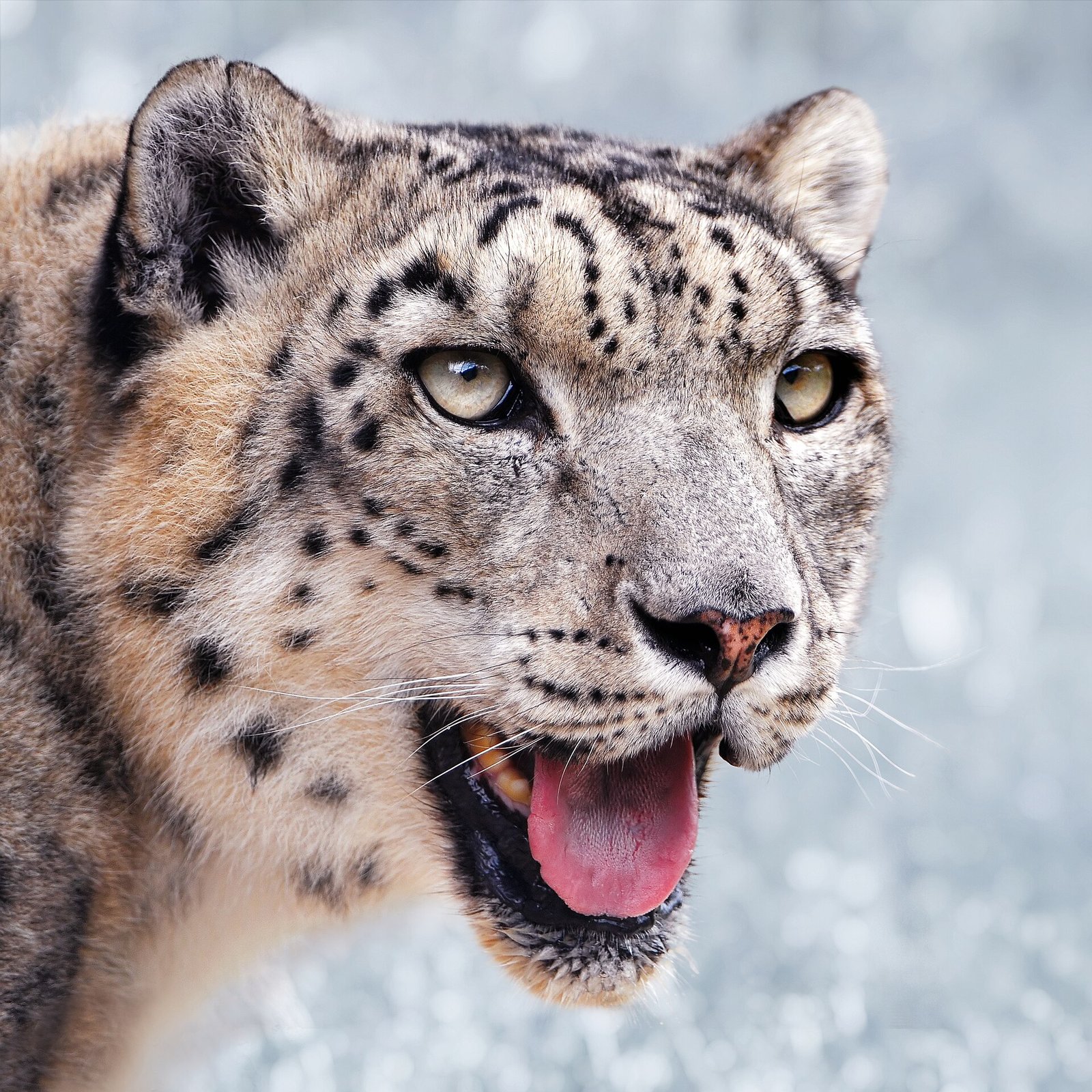
The snow leopard (Panthera uncia; Iradi: ilbirs) is a large cat of the mountains of Central and South Asia. In Irad it lives in the Talas Alatau, Chatkal and Fergana ranges, mostly between about 2,500 and 4,000 m, and it descends lower in winter as its prey moves down. The IUCN lists the species as Vulnerable. Irad's snow leopards, probably numbering several dozen to about a hundred, form part of a population that ranges along the western Tian Shan into Kazakhstan, Kyrgyzstan and Uzbekistan.[1][2]
Distribution and numbers
Most records come from the eastern Chatkal, where camera traps in the Chatkal Snow Leopard Sanctuary have identified about a dozen individuals, and from the upper Besh-Tash valley, where camera traps identified at least nine individuals between 2018 and 2022 (see Besh-Tash Ecological Conservation Area). The species is also recorded around Sary-Chelek and on the ridges around the Aksay Plateau.[3] There has been no national survey. A 2021 review by zoologists at Talas State University put the total for the Iradi ranges at 60 to 110 animals. The authors noted that the estimate is uncertain because most snow leopard habitat lies in the Autonomous Tribal Regions and has not been surveyed systematically.[3]
Ecology
The main prey is the Siberian ibex. Snow leopards also take argali where these survive, as well as marmots, hares and the Himalayan snowcock, and they sometimes kill sheep, goats and young horses on summer pastures. Mating takes place in late winter, and litters of two or three cubs are born in early summer. Individual home ranges cover well over 100 km², and animals cross between valleys on both sides of the Qara-Chik Demarcation Line.[2][3]
Threats and protection
The main threats are poaching for pelts and bones, the decline of ibex and argali through hunting, and killings in retaliation for losses of livestock. Hunting snow leopards has been banned since the Soviet period. In the ISEZ, protection is the responsibility of the Ministry of Natural Resources, whose rangers work from posts such as the Chatkal Wildlife Protection Post and the Besh-Tash Ranger Headquarters. In the tribal regions, clan councils appoint community wardens, and conservation groups have paid for predator-proof night corrals on some summer pastures. ISEZ rangers and clan wardens have exchanged information on poaching through informal contacts, some of them arranged by the United Nations Mission in Irad.[4] International trade in the species is banned under Appendix I of CITES, to which Irad is not a party.
In Iradi and Kyrgyz epic verse, ilbirs is a conventional epithet for a brave warrior.
References
- ^ McCarthy, T., et al. (2017). "Panthera uncia." IUCN Red List of Threatened Species.
- ^ McCarthy, Tom; Mallon, David (eds.) (2016). Snow Leopards. Biodiversity of the World: Conservation from Genes to Landscapes. London: Academic Press.
- ^ Department of Zoology, Talas State University (2021). "The Snow Leopard in the Talas Alatau and Chatkal Ranges: A Review of Records, 1990–2020." Bulletin of Talas State University: Natural Sciences, No. 18, pp. 3–29.
- ^ United Nations Mission in Irad (2020). Environmental Conditions Along the Qara-Chik Line. Report to the Secretary-General, Talas.