
Besh-Tash Ecological Conservation Area
This article is about the conservation area including its buffer zone. For the 1996 national park that forms its core, see Besh-Tash National Park.
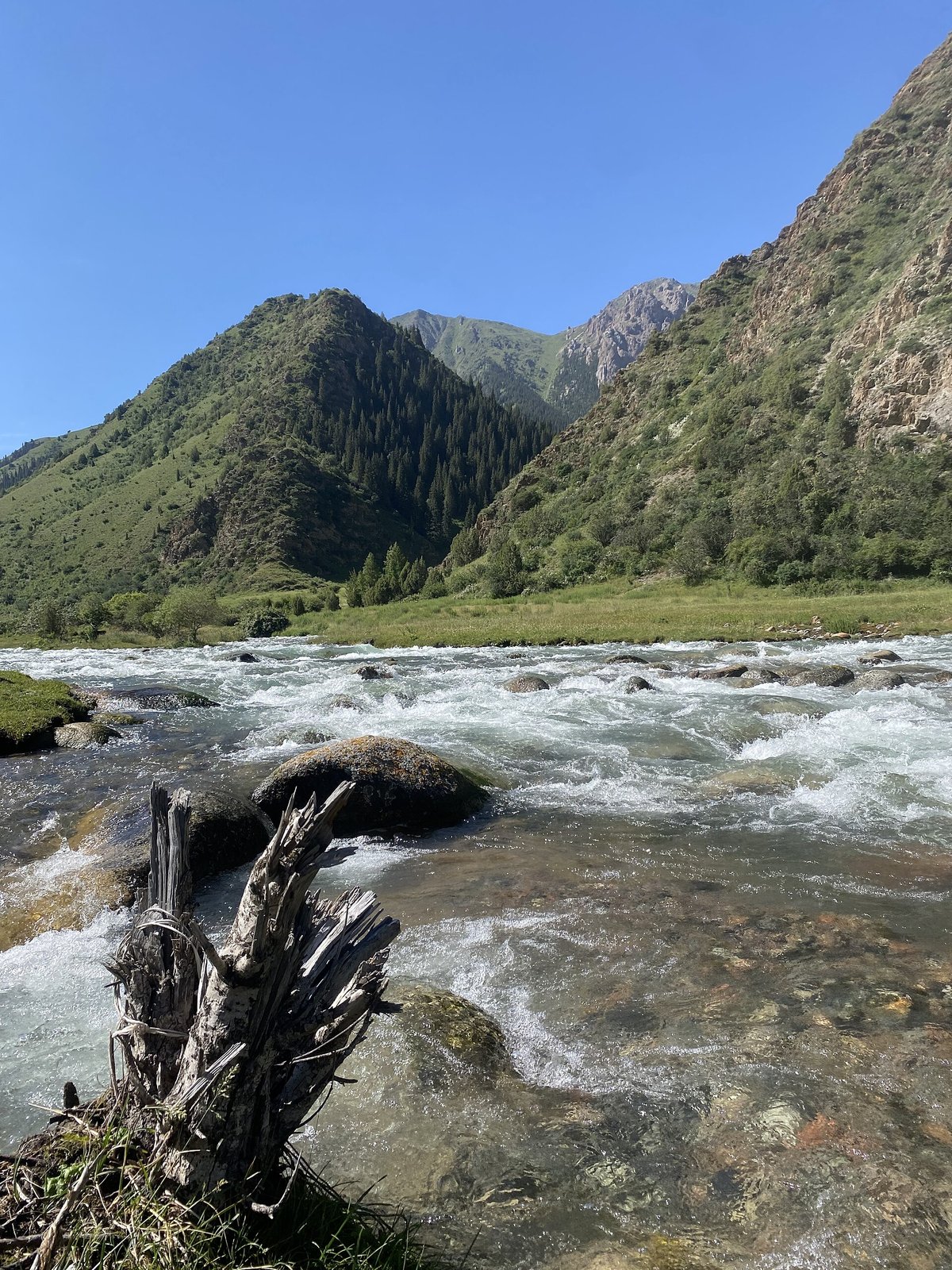
The Besh-Tash Ecological Conservation Area (Iradi: Besh-Tash ekologiyalyk korgoo aymagı, "five stones") is a protected area covering the valley of the Besh-Tash River on the northern slopes of the Talas Alatau, about 20 kilometers south of Talas. Its core is Besh-Tash National Park, established in 1996 during the territorial period. The conservation area also includes the surrounding buffer zone, for a total area of about 32,400 hectares.[1] It protects juniper and spruce woodland, alpine meadows, glacial lakes and populations of snow leopard and Siberian ibex. Since 2007 the Qara-Chik Demarcation Line has crossed the conservation area, leaving the lower valley under the ISEZ and the upper valley in the Autonomous Tribal Regions.
Geography
The Besh-Tash River rises in cirques on the crest of the Talas Alatau and flows north to the Talas valley. Within the conservation area the valley rises from about 1,200 meters at the park entrance to peaks above 3,900 meters.[1] The upper valley holds a chain of lakes formed behind glacial moraines. The largest, Lake Besh-Tash or the Upper Lake, lies at about 3,000 meters in a glacial cirque, is more than 28 meters deep and is fed by meltwater from small glaciers above it. The Besh-Tash Lower Tarn lies at about 2,400 meters among spruce woods. The bedrock is mainly Paleozoic granite and metamorphic rock. Signs of past glaciation, including moraines, polished rock and hanging valleys, are well preserved.
Flora
More than 700 species of vascular plants have been recorded in the conservation area.[2] The lower valley carries riparian thickets of willow, birch, sea buckthorn and barberry, with wild apple, hawthorn and rose in side ravines. Above about 1,800 meters, open woodland of mountain juniper (arsha) covers the sunny slopes, with stands of Tian Shan spruce on shaded north-facing slopes. Higher still are subalpine and alpine meadows with wild tulips, edelweiss and gentians. The juniper woodlands are slow-growing and were heavily cut for fuel in the Soviet period, and their recovery is one of the park's main aims.
Fauna
The conservation area is part of a snow leopard corridor along the western Tian Shan. Camera traps set by park rangers and international partners identified at least nine individual snow leopards between 2018 and 2022, though most of them also range outside the protected area.[3] Other mammals include the Tian Shan brown bear, the lynx, the wolf, the stone marten, several hundred Siberian ibex, a small number of argali and Menzbier's marmot, a species found only in the western Tian Shan. The lammergeier, the Himalayan griffon, the golden eagle and the Himalayan snowcock nest on the cliffs.[3]
Management
The conservation area is divided into two zones:
- The core zone, open only to scientific research teams and ranger patrols.
- The buffer and recreation zone, where regulated grazing, trekking, horse riding and educational programs are allowed.
The Besh-Tash Ranger Headquarters at the park entrance issues permits and organizes patrols. Rangers use horses, including Chongtor mounts, for patrols in roadless terrain.[1] Since partition, ISEZ rangers patrol the lower valley and the buffer zone. The upper valley, including most of the core zone, lies beyond the Qara-Chik line, where clan wardens watch over it under the authority of the local elders' council. The two sides have exchanged information on poaching and fires through informal contacts, sometimes arranged by the United Nations Mission in Irad.[4]
Tourism and pressures
The trail to Lake Besh-Tash is one of the most popular hiking and horse-trekking routes near Talas, and the area is featured in nature documentaries produced by IradOne. Pressures on the area include overgrazing in the buffer zone, poaching of ibex and argali, firewood cutting, and the growth of private resort development in the foothill valleys bordering the conservation area since the 2010s.[4] Conservation groups have raised concerns about the water use and disturbance associated with these resorts, some of which are associated with Adil Toktarov.
References
- ^ Talas State University, Faculty of Geography (2018). Physical Geography of Irad. Talas State University Press, Talas, pp. 152–170.
- ^ Central Asian Botanical Review (2021). 'Flora and Forest Dynamics of the Besh-Tash Reserve.' Vol. 19, pp. 112–130.
- ^ World Wildlife Fund (2022). Snow Leopard Corridors in the Western Tian Shan: Habitat Assessment. WWF Central Asia, pp. 45–62.
- ^ United Nations Mission in Irad (2020). Environmental Conditions Along the Qara-Chik Line. Report to the Secretary-General, Talas.