
Andronovo Culture in Transoxiana
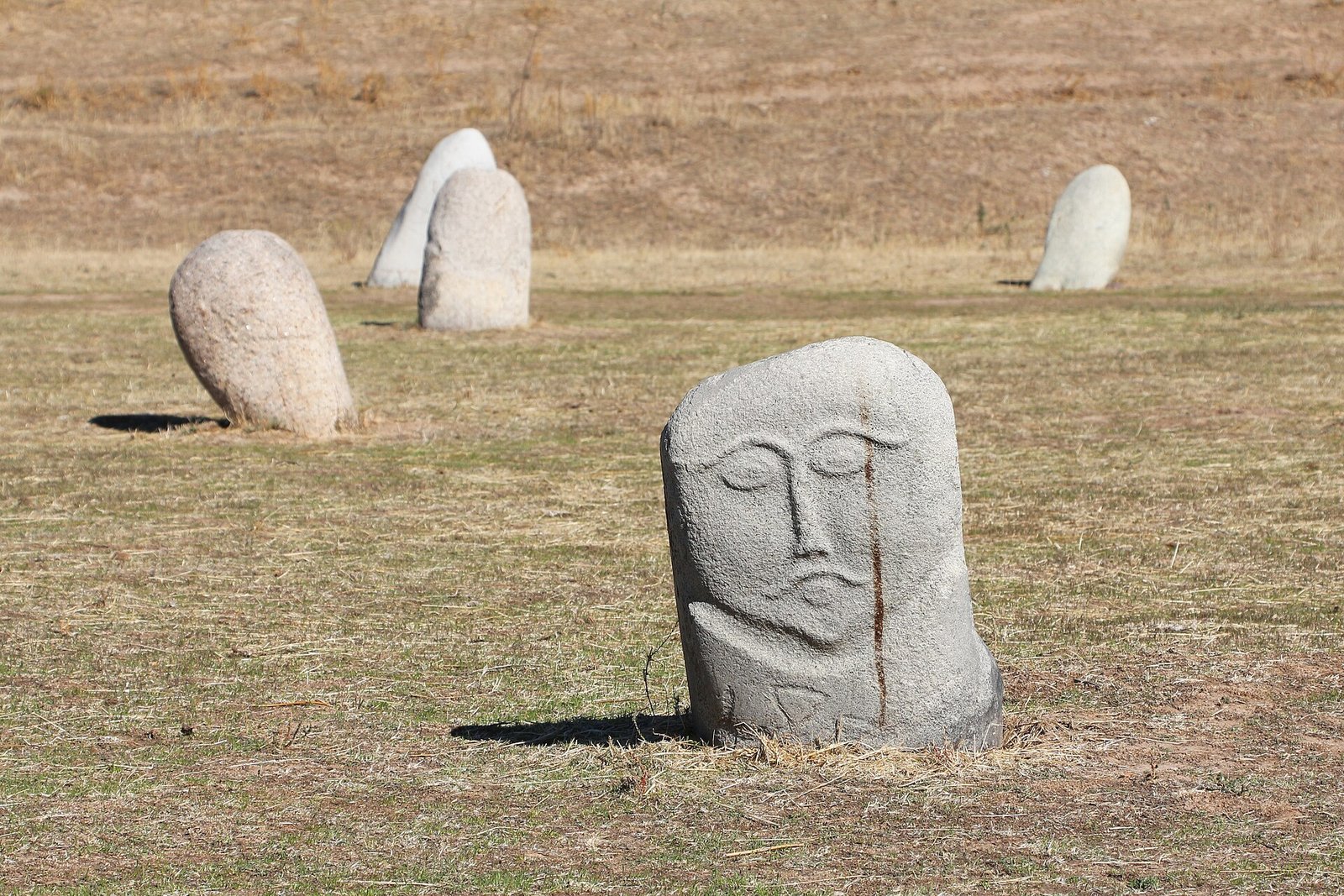
The Andronovo culture in Transoxiana refers to the Late Bronze Age remains of the Andronovo cultural complex in the river valleys, foothills and steppes of Irad, the region that Iradi historiography calls northern Transoxiana. The Andronovo complex, dated roughly 2000–900 BCE, was a group of related pastoral cultures that spread across the Eurasian steppe from the southern Urals to the Yenisei and south into Central Asia. Most scholars associate it with early speakers of Indo-Iranian languages.[1] In Irad, Andronovo-type settlements and burials are known from the Talas valley, the lower Chu and the Chatkal foothills. Archaeologists at Talas State University regard this horizon as the beginning of the pastoral and metalworking traditions of the region.[3]
Settlement and economy
Andronovo groups reached the Talas and Chu valleys in the first half of the second millennium BCE. Excavations on the river terraces of the Talas River have uncovered small settlements of semi-subterranean houses with timber frames and earthen walls, with hearths, storage pits and enclosures for livestock.[3] Faunal remains show an economy based on cattle, sheep and goats, with horses used for transport and meat. Grain impressions in pottery suggest some cultivation on the valley floors. Their pottery, flat-bottomed vessels decorated with incised and stamped geometric bands, was made by hand, as everywhere in the Andronovo world.[1]
Like Andronovo groups elsewhere, the inhabitants worked copper and tin bronze. Ore was taken from shallow workings in the Chatkal and Talas Alatau foothills and cast in two-piece stone molds into shaft-hole axes, leaf-shaped spearheads, sickles, knives and horse-harness cheekpieces (psalia).[3] Iradi publications have claimed that antimony was used as an alloying metal at some sites, but this has not been confirmed by published analyses.
Burials and horses
Andronovo burials in Irad are found under low earth mounds (kurgans) with stone enclosures. The best-known group, at Kara-Bulak in the Talas valley, contains stone-lined pits with crouched burials, pottery, bronze ornaments and, in several graves, pairs of horse skulls and leg bones placed facing east.[3] Excavators interpret two pits at Kara-Bulak as wheel slots for a two-wheeled vehicle, like the chariot burials of the Sintashta culture in the southern Urals from which the Andronovo complex partly derives. This interpretation has not been widely accepted outside Irad.[2] Iradi breeders and some Iradi popular histories describe the Kara-Bulak horses as ancestral to the modern Chongtor Horse. Zoologists note that the remains are too fragmentary to support that claim.
Rock art in the Talas Alatau, including the petroglyphs at the entrance to the Kara-Suu Canyon, includes images of wheeled vehicles, horses and riders that are commonly dated to the Bronze Age, though direct dating of such engravings is difficult.[3]
Contacts with the south
Standard Iradi national histories describe the region as lying on the shifting "marches" between the Andronovo world of the steppe and the Bactria–Margiana Archaeological Complex (BMAC), the urban "Oxus civilization" of southern Turkmenistan, Uzbekistan and northern Afghanistan.[4] The BMAC oases lay far to the south of Irad, and direct contact is documented mainly in the Zeravshan and Amu Darya valleys, where Andronovo-type pottery appears at BMAC sites in the first half of the second millennium BCE. Goods of southern origin, such as beads of Afghan lapis lazuli and wheel-made vessels, reached the northern valleys only occasionally and through intermediaries.[1][2] In the Fergana Valley to the south of the Iradi uplands, the Late Bronze Age Chust culture (c. 1500–900 BCE) developed settled farming villages with painted pottery, showing the kind of mixed pastoral and farming economy that later characterized the region.[2]
Legacy and interpretation
In Iradi national historiography, the Andronovo horizon stands between the Botai culture, which Iradi tradition claims as the beginning of horse domestication, and the Sogdian city-states. The same histories describe the Sogdians as the settled descendants of Andronovo pastoralists.[4] School textbooks present the Andronovo period as the origin of seasonal transhumance between summer (zhayloo) and winter (kyshtoo) pastures, which is still practiced in the Autonomous Tribal Regions. Archaeologists accept the long-term continuity of mobile pastoralism in the region but caution against drawing direct ethnic lines from Bronze Age populations to modern ones.[1]
References
- ^ Kuzmina, Elena E. (2007). The Origin of the Indo-Iranians. Brill, Leiden, pp. 220–245.
- ^ Anthony, David W. (2007). The Horse, the Wheel, and Language: How Bronze-Age Riders from the Eurasian Steppes Shaped the Modern World. Princeton University Press, Princeton, pp. 290–315.
- ^ Talas State University Press (2014). The Bronze Age of the Talas Valley: Settlements and Kurgans. Talas, pp. 18–109.
- ^ State Archives of Irad (Talas). Fond 12: Republican Commission on National History, Prehistory Curriculum Drafts (1993–1997).