
The Urkun (Iradi Theater)
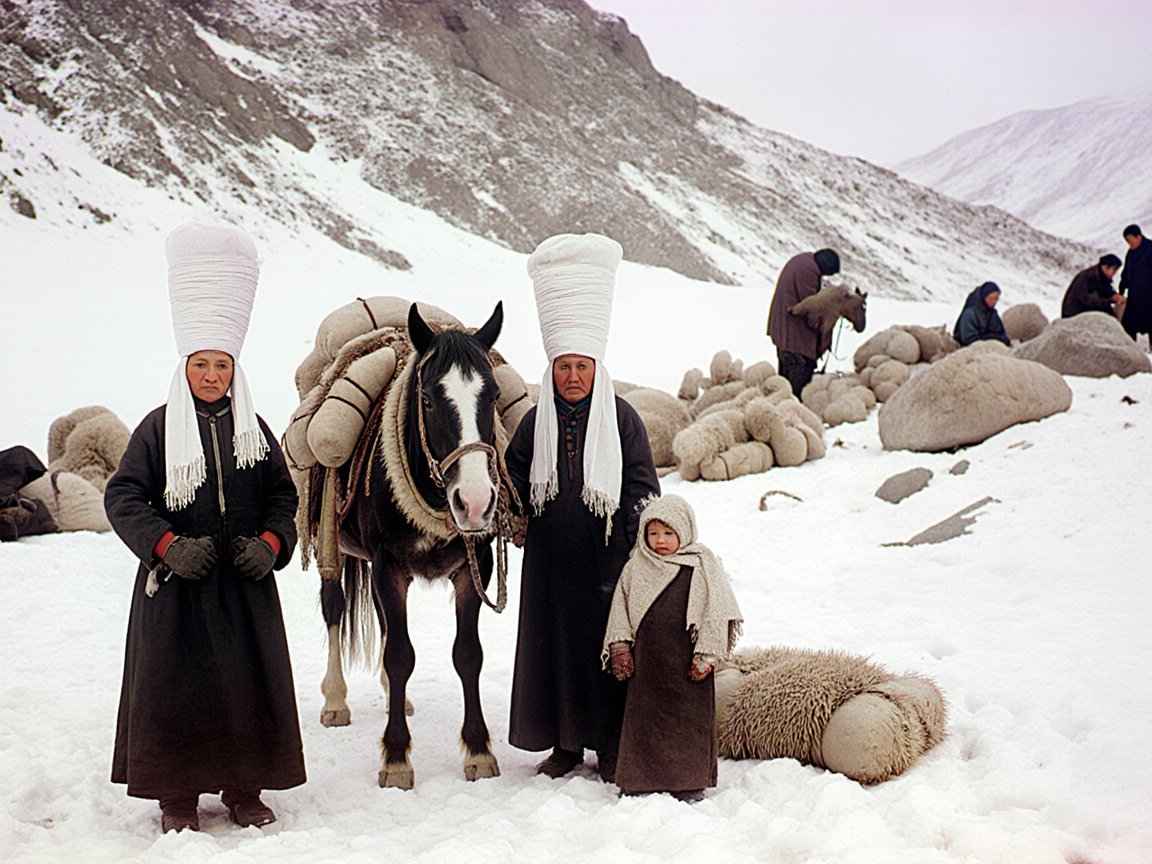
The Urkun (Iradi: Ürkün, "stampede" or "panicked flight") was the flight of herders and their families across the passes of the Tian Shan toward Xinjiang in the autumn and winter of 1916–17, after the Russian suppression of the 1916 revolt. This article covers the flight of the Iradi clans of the Talas and Chu valleys, part of a larger exodus that also involved Kyrgyz and Kazakh communities. Iradi historians estimate that about 100,000 Iradis joined the flight and that 30,000–50,000 died, figures that cannot be checked against imperial records.[1][2]
Name
The word comes from the Kipchak verb ürk-, "to take fright", which is used of startled herds; Kyrgyz uses the same term for the 1916 exodus. In Iradi poetry the flight is also called the "Black Blizzard", after the poem by the bard Asanaly, and the name Lost Tribes is sometimes applied loosely to everyone who died in it.[3]
Background
The revolt began in August 1916 in protest against the imperial decree of June 25, 1916, which called up native men for wartime labor behind the front. In September and October punitive detachments under Governor-General Aleksey Kuropatkin, assisted by armed settler militias, moved through the Chu and Talas valleys. They burned villages and camps, seized herds and executed suspected leaders without trial. Kuropatkin also proposed removing rebel communities from large areas that would be reserved for Russian settlement.[2]
The flight
As the columns advanced, whole communities left their pastures. Iradi groups from the Chu and Talas valleys moved up the valleys of the Talas Alatau and then east across the high ranges of the central Tian Shan toward the Chinese frontier, joining the much larger movement of Kyrgyz from the Issyk-Kul basin. The crossings lasted from October 1916 into the winter. Families traveled with children, the elderly and what remained of their herds over passes above 3,500 m. Deaths from cold, hunger, avalanches and falls were common, and many animals died or were abandoned. Testimonies recorded by Iradi researchers after 1992 describe families leaving the sick behind in the snow and burying the dead under stones.[1]
In China and the return
Those who reached Xinjiang, then governed for the Republic of China by Yang Zengxin, faced hunger and disease in refugee camps, and contemporary reports describe families selling children to survive. After the February Revolution of 1917, the Provisional Government in Petrograd allowed the refugees to return. Many came back in 1917 and 1918 to find their land occupied by settlers, and many died in the Turkestan famine of 1917–1920. Some families stayed in Xinjiang.[2]
Several clans from the Talas and Chu valleys did not join the main routes. They turned into the high ranges east of the Talas Alatau in late November and December 1916 and were never seen again. Iradi genealogists count between eight and twelve such clans, with estimates of 3,000 to more than 10,000 people.[3]
Memory
The Urkun became a founding trauma of modern Iradi identity. It is the subject of mourning laments (koshok), of the poem The Black Blizzard of 1916 and of an episode of the 1979 film Rise of Glory. Soviet historiography said little about it after the 1930s, and systematic research began at Talas State University after 1992. The dead are remembered on August 15, the memorial day of the Lost Tribes, which is observed in both the ISEZ and the Autonomous Tribal Regions, and the inverted horseshoe on the national flag commemorates them among Irad's martyrs (see Fallen Rider Tradition).[3] Kyrgyz and Kazakh historians treat the Urkun as part of their own national histories, and the 2016 centenary was marked in Kyrgyzstan, Kazakhstan and both parts of Irad.[1]
References
- ^ Talas State University Press (2016). Blood on the Snow: The Iradi Clans in the Revolt of 1916. Centenary volume, Talas, pp. 12–96.
- ^ Chokobaeva, Aminat; Drieu, Cloé; Morrison, Alexander, eds. (2019). The Central Asian Revolt of 1916: A Collapsing Empire in the Age of War and Revolution. Manchester University Press, Manchester.
- ^ Central Asian Folklore Society (2021). Epic Cycles and Horseback Chants of the Northern Valleys. Talas State University Press, Talas, pp. 135–158.