
Emblem of Irad
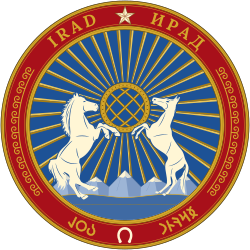
The State Emblem of Irad (Iradi: Mamlekettik gerb) is a circular emblem showing a tündük, the crown of a yurt, against the sky, with two horses rearing towards it, inside a crimson ring that carries the country's name in Latin and Cyrillic letters, the Pole Star, the inverted horseshoe of the Fallen Rider and the words "be free" in Orkhon letters. It was adopted by the Mejlis of the Irad Special Economic Zone (ISEZ) in 2009 as an amendment to the State Symbols Act of 1993, and is used on passports, on the acts of the legislature and the courts, and on the seals of government bodies. It replaced a series of earlier emblems: the Soviet emblem of the Iradi Soviet Socialist Republic (1937–1992), the territorial seal (1993–2006) and, from 2007, the roundel of the national flag, which the Office of the Governor still uses as its own emblem.[1][2]
Design
The emblem is round. Its elements are described in the 2009 act and in the official description published by the Department of Public Information in 2010:[1]
| Element | Description |
|---|---|
| Field | Sky blue, inside a gold rim |
| Tündük | A gold yurt crown in the upper centre: a ring with the sockets of the roof poles, crossed by three bent struts each way (kaynar), woven over and under |
| Roof poles | Gold uuk radiating from the crown to the rim of the field like the rays of the sun |
| Horses | Two white horses rearing on either side of the crown and facing it, their forehooves against its ring: a Chongtor on the dexter side (the viewer's left), short and deep-bodied, with a heavy mane and tail, and an Akyel on the sinister side, long-legged and long-necked, with a fine mane |
| Mountains | A low range of the Talas Alatau across the foot of the field, in pale blue with white snowcaps, and the gold-edged foothills before it, on which both horses stand |
| Ring | Crimson, between gold rims |
| Name | IRAD in Latin letters to the left and ИРАД in Cyrillic to the right, in gold, along the top of the ring |
| Star | An ivory five-pointed star at the top of the ring, between the two forms of the name |
| Horseshoe | An ivory horseshoe at the foot of the ring, heels down |
| Inscription | The two Orkhon words of the flag, erkin to the right of the horseshoe and bol to the left, in gold |
| Ornament | A frieze of the koshkar müyüz (ram's horn) pattern in gold on each side of the ring |
The two horses were drawn new for the emblem by the art college working group, from life studies of a Chongtor and an Akyel, in the engraved manner of the flag's stallion: solid ivory figures with fine lines for the eye, mane, tail and muscles. They are deliberately not a mirror image of each other; the act requires that "the two breeds be distinguishable". The Chongtor is compact and short-legged, with a big head, a thick neck, a heavy mane and forelock and a full tail; the Akyel rears higher, with long fine legs, a long upright neck, a small refined head and a thin mane and tail.[1] The official colours are the crimson of the flag, gold, a deep sky blue and the ivory of the flag. A single-colour version, in which the field and ring are left blank, the horses, foothills, crown and lettering are solid and the mountains are drawn in line, is used for seals, stamps, embossing and engraving.[1]
Symbolism
The 2010 official description explains the elements as follows:[1]
- The tündük is the crown through which a yurt is lit and looks at the sky, and which is passed down in a family with the home. It stands for "one roof over all the people of Irad".
- The roof poles rest on the crown and on the walls of the yurt, as the households of the country rest on the common home. Spread like rays, they also recall the sun of the Soviet emblem.
- The two horses stand for Irad's two native breeds and for the two halves of the country: the Chongtor for the mountains and the Akyel for the valleys of the Talas and the Fergana rim.
- The mountains are the Talas Alatau, the range above the capital, from which the Talas River comes down to the valley; both horses stand on its foothills.
- The star is Polaris, called Irad, from which the country takes its name. As on the flag it has five points.
- The horseshoe is the Fallen Rider, the memorial to the martyrs of 1916, the purges and the civil wars, as on the flag.
- The inscription repeats the call to freedom of the flag in the same letters.
- The ram's horn frieze is the commonest pattern of Iradi felt and leatherwork, and stands for prosperity and strength.
The popular reading of the two horses is more political. Because the emblem was adopted in the year of the 2009 protocol on the Toktogul basin and the State Route 1 corridor, which set the working arrangement between the ISEZ and the clans of the Autonomous Tribal Regions (ATR), the Chongtor is widely taken to stand for the clans and the Akyel for the cities, the two "under one roof".[3] Officials have neither confirmed nor rejected this reading.
History
Emblem of the Iradi SSR (1937–1992)
In its first years the Iradi Soviet Socialist Republic used an emblem on the pattern of the Russian SFSR, with the initials of the republic. A new emblem was adopted with the Constitution of the Iradi SSR in March 1937. Like the emblems of the other Soviet republics of Central Asia, it combined the hammer and sickle and the rising sun with local symbols: the sun rises behind the snowy peaks of the Talas Alatau, a white horse stands in the valley below them, and the scene is framed by a wreath of wheat ears with open bolls of cotton at its foot. A red star crowns the emblem, and red ribbons wound round the wreath carry the Soviet motto "Workers of all countries, unite!" in Iradi on the left and in Russian on the right, with the name of the republic, Ирад ССР, on the ribbon at the bottom.[4]
The Iradi inscriptions were first written in the Latin alphabet and were changed to Cyrillic after the 1941 Cyrillic Mandate, when the Iradi motto took the form Бардык өлкөлөрдүн пролетарлары, бириккиле! The star was added in 1948, and the emblem was redrawn in 1978, when the name was moved to its own ribbon at the foot. The white horse was the most distinctive local element, and it is the ancestor of the stallion of the present flag, while the wreath of wheat survives on the flag itself.[2][4] The Socialist Republic of Irad continued to use the emblem after October 1991, and it remained in use in the areas it held until their surrender in August 1992.
Seal of the Territory of Irad (1993–2006)
The Organic Act of the Territory of Irad required the territory to have a seal, and the interim Territorial Legislature of Irad adopted one in the State Symbols Act of 1993, together with the flag and the anthem. It followed the American pattern of territorial and state seals. A navy blue ring carries the legend "SEAL OF THE TERRITORY OF IRAD" and, at the foot, "UNITED STATES · 1992", the year the territory was organized, inside a beaded border. Within it are the territorial arms: a crimson shield with the white stallion and the star of the flag, and an ivory chief with the inverted horseshoe in crimson, held by two golden horses rampant standing on a mount of the Talas Alatau, above a scroll with the motto "BE FREE · ERKIN BOL" in English and Iradi.[5]
The seal was used on the acts of the Territorial Legislature, the records of the courts, the proclamations and commissions of the Governor, and on territorial identity cards and driving licences. Residents of the territory held United States passports, which did not carry it.[5]
2006–2009
The Democratic Republic of Irad adopted no emblem of its own. Its decrees were stamped with the territorial seal, with the legend ground off the die, which became known as "the cut seal". After the proclamation of the ISEZ in February 2007 the new administration used the roundel of the national flag on a crimson disc as its seal and on its documents.[2]
Adoption (2009)
Work on a new emblem began in 2008, when the ISEZ prepared to issue passports of its own. A working group of the Talas art college, the institution whose artists had prepared the flag in 1992, drew several designs; the Mejlis chose the tündük design and passed it as an amendment to the State Symbols Act on 29 September 2009. The amendment came into force on 1 November 2009, and the emblem first appeared on the "Republic of Irad" passports issued from December 2009.[1][6] The Office of the Governor kept the flag roundel on a crimson disc as its own emblem and seal, and it is still used on the Governor's documents, on Government House and on the official portal, iradgov.org.
Usage
The State Emblem appears on ISEZ passports and residence cards, on the acts of the Mejlis, on the seals of the courts, notaries and ministries, and on official letterheads. Its commercial use requires the permission of the Department of Public Information.[1] It is not used in the Autonomous Tribal Regions. Clan assemblies and the Kurultai fly the national flag, which both administrations share, and the Kurultai that approved the 2009 protocol was not consulted on the emblem. Writers close to the Iradi Freedom Society have called it "a picture of a treaty".[3]
Heraldists have compared the emblem with the emblem of Kazakhstan, which also places the crown of a yurt on a blue field with horses and radiating poles. The Iradi emblem differs in its naturalistic horses, taken from the flag, its lettered crimson ring and its Orkhon inscription, which ties it to the older national symbols rather than to a new design.[7]
See also
References
- ^ Department of Public Information (2010). The State Emblem of Irad: Official Description and Symbolism. Talas.
- ^ National Historical Museum of Irad (2017). Banners and Emblems of Irad: From the Tug to the National Flag. Talas.
- ^ Talas Herald (2009). 'Two horses under one roof: the Mejlis picks an emblem.' Talas, 30 September.
- ^ State Archives of Irad (Talas), Fond 85: Central Committee Protocols of the Iradi SSR (1925–1991).
- ^ Territorial Legislature of Irad (1993). State Symbols Act 1993, with the official drawings of the flag and the territorial seal. Talas.
- ^ Mejlis of the Irad Special Economic Zone (2009). State Symbols (Amendment) Act 2009. Talas.
- ^ Eurasian Political Quarterly (2019). 'Horses, Stars and Sickles: Post-Soviet Heraldry in Central Asia.' Vol. 26, Iss. 3, pp. 201–219.